 English
 Français

Which Type of Auto Phone Holder Is Best in 2026?
An Auto Phone Holder can make navigation easier, but the right design depends on your car and daily route. A vent clip keeps the dashboard clear, though heavy phones may make some vents sag. A suction mount offers flexible positioning, but its grip can weaken on dusty or textured surfaces. Cup-holder mounts feel sturdy and sit within easy reach, yet may crowd the console. Small details matter. Check the phone’s weight, case thickness, mount adjustment, and charging needs before choosing.
Safety matters more than convenience. NHTSA’s 2022 Traffic Safety Facts report recorded 3,308 deaths in distraction-affected crashes. A holder cannot prevent distraction, but it can reduce the need to search for a loose phone. AAA Foundation for Traffic Safety research also cautions that hands-free use does not remove cognitive distraction. Keep the screen visible without blocking your forward view, and set navigation before driving. Wireless charging can help on longer trips, though heat and cable placement deserve attention. There is no universal winner. A compact vent mount may suit a short commute, while a stable dashboard or cup-holder model may work better on rough roads. Even careful buyers can miss one thing: how the mount feels after a week of real use. Test placement while parked, then reassess.
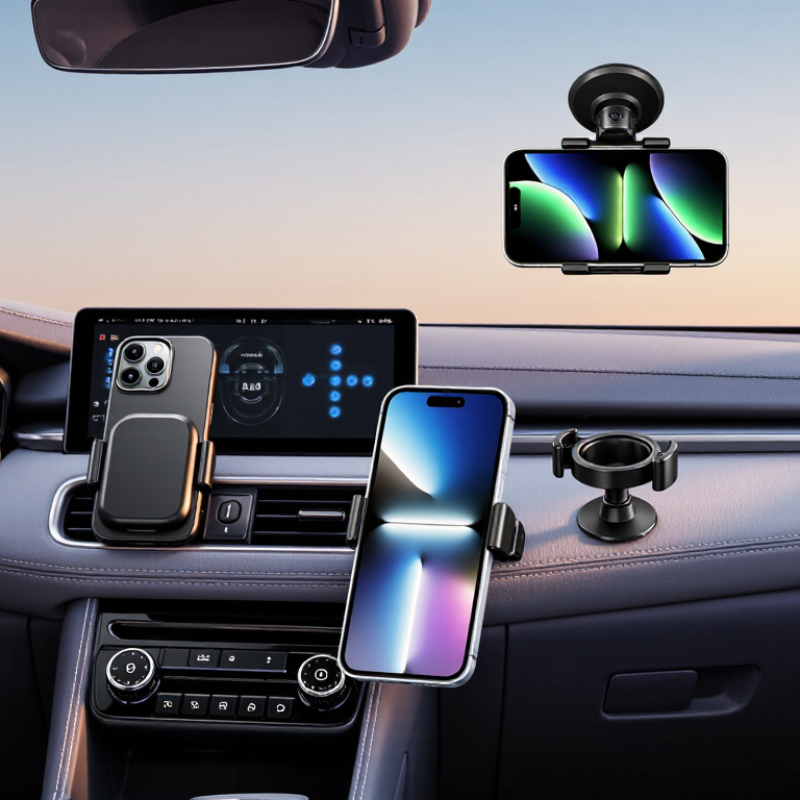
What an Auto Phone Holder Is and How It Works
An auto phone holder is a small mount that keeps a phone steady and reachable inside a vehicle. It may attach to the dashboard, air vent, windshield, or cup-holder base. The phone rests in a cradle, between spring-loaded arms, or against a magnetic plate. Some mounts use suction; others rely on clips or a weighted base. The holder does not make phone use automatically safe. It simply helps prevent sliding and makes a brief glance easier. Small detail, big difference: a loose charging cable can still tug the phone sideways.
Most holders work by securing the mount to a stable surface, then gripping or attracting the phone. A basic cradle adjusts to different phone widths, while a magnetic design needs a compatible plate or case. Some models also support wireless charging, but charging speed and heat can vary. In everyday use, the best position is easy to reach without blocking the driver’s view or important controls. Not always simple. A vent mount may shift when the vent is bumped, and suction can weaken on textured dashboards. Check the fit while parked, then make small adjustments before driving. No design is perfect; the right choice depends on the vehicle, phone, and where the mount stays firm.
Which Type of Auto Phone Holder Is Best in 2026? - What an Auto Phone Holder Is and How It Works
An auto phone holder is a vehicle accessory that secures a phone in a visible, reachable position. It attaches to a suitable part of the vehicle and holds the phone with a clamp, magnet, cradle, or adjustable support. The best type depends on the vehicle layout, phone, and preferred mounting position.
| Holder type | How it attaches and holds the phone | Best suited for | Things to consider |
|---|---|---|---|
| Air-vent mount | A clip grips a vehicle air-vent louver; a cradle or magnet holds the phone. | Drivers who want a compact mount near the dashboard without attaching it to the windshield. | Vent shapes vary. The mount may obstruct airflow, and hot or cold air can blow directly onto the phone. |
| Windshield suction mount | A suction cup creates a seal against a smooth windshield surface; an arm positions the phone. | Vehicles with a suitable windshield area and drivers who prefer an elevated viewing position. | Dust, textured surfaces, and temperature changes can affect the seal. Position it without obstructing the driver’s view. |
| Dashboard suction mount | A suction cup attaches to a smooth dashboard area, sometimes using a separate mounting disc. | Drivers seeking a lower position and a dashboard surface compatible with suction mounting. | Many dashboards are curved or textured, which can prevent a reliable seal. Check surface compatibility before installation. |
| Adhesive dashboard mount | An adhesive base bonds to a selected dashboard surface; a cradle or magnetic head holds the phone. | Vehicles with a suitable flat or gently curved mounting area where a fixed position is preferred. | Adhesive may leave residue or affect some finishes, and the mount can be difficult to reposition. Follow the surface and product instructions. |
| Cup-holder mount | An adjustable base fits inside a cup holder and supports a stem-mounted phone cradle. | Vehicles with a compatible cup holder and drivers who want to avoid windshield or dashboard attachment. | It occupies a cup holder and may place the phone lower or farther from the driver than other mount types. |
| CD-slot mount | A tab or adjustable insert fits into a vehicle’s CD slot and supports a phone cradle. | Vehicles with an unused CD slot in a convenient position. | It is unsuitable if the vehicle has no CD slot or the slot is needed. Check that the mount does not obstruct controls or the display. |
| Magnetic mount | A magnet on the mount attracts a compatible metal plate or magnetic phone accessory. | Drivers who value quick one-handed attachment and removal, provided the phone setup is compatible. | The phone needs a compatible magnetic interface. Plate placement and phone-case design can affect wireless charging. |
| Wireless-charging mount | A powered mount holds the phone in alignment with a wireless charging coil to transfer power without a charging cable plugged into the phone. | Drivers whose phones support the mount’s wireless charging standard and who want charging while mounted. | The mount needs vehicle power. Phone alignment, case thickness, and charging-standard compatibility can affect charging. |
Practical choice: Match the mount to a stable, compatible location in your vehicle and to the way your phone is held or charged. Keep the holder clear of airbags, essential controls, and the driver’s field of view.