7 Best Automated Forklifts for Warehouses in 2026

    Warehouses are moving from fixed conveyor routes toward flexible, software-directed material handling. The Automated Forklift now operates between receiving docks, storage aisles, and packing stations with limited human intervention. Its sensors read pallet positions, aisle boundaries, and unexpected obstacles in real time.

    The MHI 2024 Annual Industry Report found that 83% of supply-chain professionals expect greater robotics and automation adoption within five years. Interact Analysis also forecasts continued expansion in warehouse automation, driven by labor shortages, faster fulfillment, and rising operational complexity. The International Federation of Robotics reported strong growth in professional service robots for transportation and logistics. These figures support the market direction, but they do not guarantee immediate savings. Site layout, pallet quality, software integration, and worker training still decide practical performance.

    Ash Sharma, Managing Director at Interact Analysis, has emphasized that automation succeeds when technology fits the workflow, rather than chasing novelty. That warning matters. An Automated Forklift may look impressive under showroom lighting, yet struggle with damaged pallets or narrow, crowded aisles. This guide examines seven leading systems for 2026, comparing navigation, payload capability, safety features, fleet software, charging options, and deployment support. Some rankings remain debatable. They should. Warehouse conditions differ sharply, and a costly machine is not automatically the best machine. The right choice should leave fewer idle minutes, safer pedestrian crossings, and clearer data on every pallet movement.
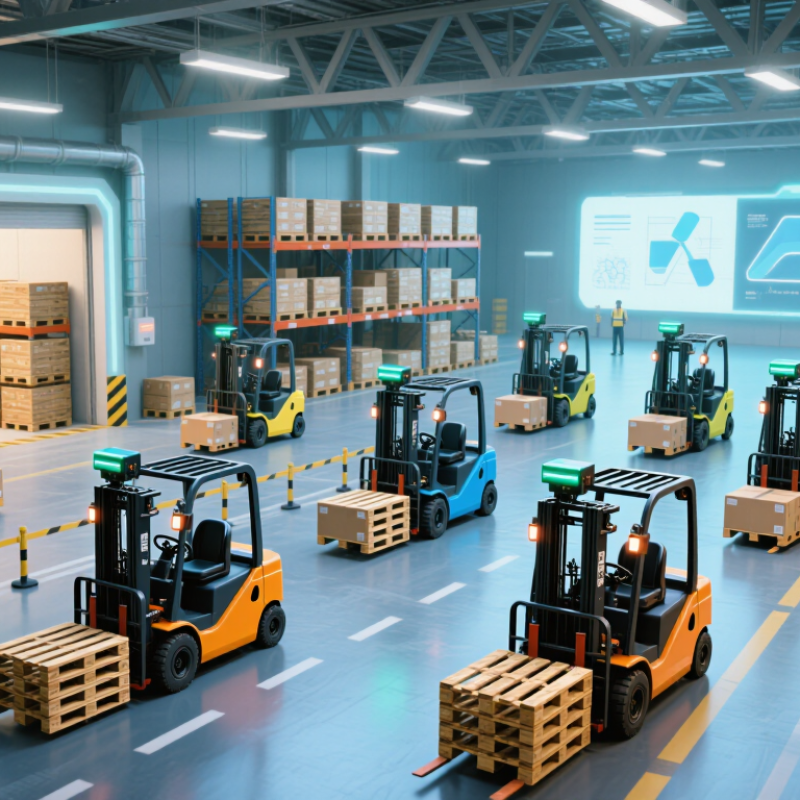
    7 Best Automated Forklifts for Warehouses in 2026

    What Are Automated Forklifts and How Do They Work?

    Automated forklifts are industrial vehicles that move, lift, and place pallets with limited human control. They follow digital routes instead of relying on a driver in the cab. In practical warehouse trials, they often handle repetitive transfers between storage aisles, packing zones, and loading docks. Their value is clearest during long shifts, when fatigue can affect driving accuracy.

    These forklifts use cameras, laser scanners, sensors, and warehouse software to understand their surroundings. A control system compares the vehicle’s position with a stored map. It can identify racks, floor markings, people, and unexpected obstacles. Load sensors check whether a pallet is centered and within the rated capacity. At a receiving dock, the system may collect a pallet, confirm its location, and deliver it to an assigned slot. It slows near corners and stops when a person enters its path. That pause matters.

    They are not flawless. A damaged barcode, dark floor surface, or misplaced pallet can interrupt a route. Software also depends on accurate inventory data and clearly defined traffic rules. Warehouse teams should test emergency stops, battery charging, pedestrian alerts, and manual handover procedures before full deployment. In my experience, the hardest part is often not navigation. It is changing daily habits. Workers may need time to trust a vehicle that moves quietly and makes decisions without visible instructions. Human supervision still matters, especially during unusual tasks, maintenance, and congested shifts.

    Key Criteria for Evaluating Automated Forklifts in 2026

    Key Criteria for Evaluating Automated Forklifts in 2026

    Choosing an automated forklift starts with the work it must actually do. Record typical pallet weights, load dimensions, travel distances, and peak-hour traffic. A truck rated for the average load may struggle with an occasional heavier pallet.

    Check lift height, turning radius, and aisle clearance against measured warehouse conditions. Small floor cracks or changing lighting can also affect performance, depending on the navigation system.

    Evaluate how the vehicle detects people and obstacles, and how it behaves when a route is blocked. Ask for clear evidence from tests in a representative work area, not only a polished demonstration.

    Confirm integration with warehouse software, charging plans, maintenance response, and operator training. Compare total operating costs, including downtime and infrastructure changes.

    No system removes every bottleneck; poorly planned routes can simply move congestion elsewhere. That detail is easy to overlook.

    Tips: Before selection, map one busy shift and note crossings, blind corners, and waiting points. Test with real pallets. Keep a manual fallback plan, and review safety settings after layout changes. A pilot may reveal awkward exceptions; that is useful, even if it complicates the schedule.

    Seven Leading Automated Forklifts for Warehouse Operations

    Automated forklifts are not one-size-fits-all. The best fit depends on load weight, aisle width, floor condition, and traffic patterns. The International Federation of Robotics’ World Robotics 2024 report recorded 113,000 transport and logistics service robots sold in 2023. That signals growing adoption, not guaranteed savings. Fit matters.

    Seven configurations suit different warehouse jobs.

    Automated pallet trucks move loads across smooth floors and busy dock areas.
    Stackers lift pallets into low racks where space is limited.
    Counterbalance trucks handle mixed loads near loading bays.
    Reach trucks work well in taller, narrower aisles.
    Very-narrow-aisle turret trucks access dense storage with little turning room.
    Order pickers support piece-picking tasks at elevated levels.
    Tow tractors pull carts along repeatable routes between work zones.

    MHI’s 2024 Annual Industry Report found that 55% of surveyed organizations planned to increase supply-chain technology investment. That interest makes careful trials more important, not less. Test routes with real pallets, shift patterns, and pedestrian traffic. Check how each vehicle handles blocked aisles and changing priorities. Damaged pallets can disrupt even a well-planned route. Sometimes a simpler truck is the better choice.

    Comparing Performance, Safety, Costs, and Best-Use Scenarios

    Choosing among the seven best automated forklifts for warehouses in 2026 depends on the work, not just travel speed. Autonomous pallet trucks suit steady, floor-level transfers between receiving and storage. Counterbalance models handle heavier loads and varied pallets, while reach trucks fit high-bay aisles. Stackers can be a lower-cost option for lighter loads and shorter lift heights. Tugger-style vehicles move several carts efficiently, but need clear routes. Very-narrow-aisle models save floor space and demand precise navigation.

    Compare performance during representative shifts. Measure completed moves, charging interruptions, and delays at shared crossings. Safety features matter, but marked walkways, stable pallets, and sensible speed settings matter too. Costs include integration, floor repairs, staff training, batteries, and maintenance—not just the purchase price. One uncomfortable truth: automation can expose messy inventory data rather than fix it. A perfectly routed vehicle still struggles when pallet locations are wrong.

    Tips: Trial the vehicle with your real loads and busiest routes. Check stopping distance near blind corners. Ask who reviews incident logs and updates routes after layout changes. A short pilot may reveal bottlenecks that a polished demonstration misses.

    7 Best Automated Forklift Types for Warehouses in 2026: Performance, Safety, Costs, and Best-Use Scenarios
    Automated forklift type Typical performance envelope Best-use scenarios Safety considerations Relative cost Main trade-off
    1. Automated low-lift pallet truck Typical rated load: about 1.0–2.0 tonnes. Lifts a pallet just clear of the floor; designed mainly for horizontal transport. Travel speed and load rating depend on the model and operating conditions. Regular pallet transfers between receiving, production, staging, and shipping areas; repeatable routes on mostly level floors. Plan pedestrian crossings, turning areas, and load-stability controls. Use the truck’s obstacle detection alongside clearly marked routes and appropriate site traffic rules. Low to medium. Usually one of the simpler options to deploy when routes and hand-off points are predictable. Does not provide high-level storage or complex pallet placement.
    2. Automated walkie stacker Typical rated load: about 0.8–1.6 tonnes. Lift heights commonly range from roughly 1.6–5 metres, subject to configuration and mast design. Low- to medium-height rack storage, replenishment, and pallet moves in smaller facilities or areas with moderate throughput. Assess load height, mast visibility, floor condition, and pedestrian exposure. Rack clearances and load placement need to be validated for the actual truck. Low to medium. Can suit operations that need stacking without a larger counterbalanced truck. Lower lift capacity and operating envelope than many ride-on warehouse trucks.
    3. Automated counterbalanced forklift Typical rated load: about 1.0–3.5 tonnes. Common lift heights are approximately 3–6 metres; exact capacity decreases as load centre and lift height increase. Mixed indoor tasks, dock transfers, floor-level pallet handling, and operations that need a versatile truck with front forks. Check turning space, reversing and crossing points, dock edges, and mixed-traffic areas. Rated capacity must be checked against the load centre and lift height. Medium to high. Cost rises with capacity, navigation requirements, and integration with warehouse systems. Requires more manoeuvring space than many dedicated narrow-aisle solutions.
    4. Automated reach truck Typical rated load: about 1.0–2.0 tonnes. Depending on the design, lift heights can be around 6–11 metres. Aisle needs vary with truck geometry and pallet dimensions. High-bay pallet storage in selective-rack warehouses where efficient use of vertical space matters. Verify rack tolerances, aisle clearances, floor flatness, and load stability at height. Establish safe separation from people and manual vehicles. High. Typically requires more precise site preparation and rack-to-truck coordination than floor-level transport. Best suited to defined storage aisles; less flexible for frequent work across open areas.
    5. Automated double-deep reach truck Designed to place pallets two positions deep in compatible racking. Capacity and maximum lift height depend on the truck, load centre, and attachment configuration. Warehouses seeking greater storage density than single-deep selective racking, with reasonably consistent pallet sizes and inventory flows. Confirm visibility and accurate pallet positioning at both rack depths. Rack design, pallet condition, and load dimensions must match the truck’s operating limits. High. The truck and compatible racking may require coordinated investment and detailed commissioning. Access to rear pallet positions can be less direct, reducing selectivity compared with single-deep storage.
    6. Automated very-narrow-aisle turret truck Designed for guided operation in narrow aisles and high-bay storage. Lift heights can reach roughly 10–15 metres on suitable configurations; load capacity and aisle width are model- and site-specific. High-throughput facilities where land or floor area is constrained and storage density is a priority. Requires carefully engineered aisle guidance, rack alignment, floor tolerances, and pedestrian exclusion or protection measures. Validate emergency access and recovery procedures. Very high. Often involves substantial facility, rack, guidance, and systems-integration requirements. High storage density, but comparatively limited flexibility if aisle layouts or operating processes change.
    7. Automated order-picking truck Performance varies by design: some units carry a picking platform or operator, while others support goods-to-person workflows. Platform height, load capacity, and travel speed are configuration-specific. Piece-picking operations that need to move pickers or order containers through defined warehouse routes. For platforms carrying people, assess access, fall protection, emergency lowering, and the exact operating mode. Keep pedestrian interaction and pick-face access in the safety assessment. Medium to very high. Cost depends strongly on whether the system carries a person, integrates with picking software, or supports automated goods-to-person handling. Can improve movement between pick locations, but does not remove the need to design safe and efficient picking processes.

    How to interpret this comparison: These are equipment categories, not brand-specific product specifications. Performance ranges are indicative; actual capacity, lift height, speed, aisle width, and suitability depend on the selected configuration, load, floor, rack, and operating conditions. Compare total installed cost, including charging, navigation, software integration, site preparation, training, maintenance, and any required rack changes. For driverless industrial trucks and industrial mobile robots, assess the complete system against applicable safety requirements, including ISO 3691-4 and, where relevant, ANSI/RIA R15.08.

    How to Select and Implement the Right Automated Forklift

    Choosing an automated forklift starts with the work, not the feature list. Record typical pallet weights, load dimensions, travel distances, and peak-hour traffic. Measure twice. Aisle width, turning space, floor joints, and dock transitions can rule out a machine that looks suitable on paper. Check whether it can handle the actual rack heights and the loads your team moves each shift.

    Then compare navigation methods, safety functions, charging needs, and compatibility with warehouse software. Ask vendors to demonstrate the forklift on your site, using real routes and representative loads. A short pilot can reveal blind corners, congestion near packing stations, or unreliable floor markings. No pilot catches everything. Leave time to review near misses and adjust routes before expanding deployment.

    Implementation also depends on people and daily routines. Assign staff to manage exceptions, clear blocked paths, and perform documented inspections. Train operators on safe interactions, emergency stops, and recovery procedures—not just routine operation. Track completed trips, downtime, charging patterns, and manual interventions during the first weeks. Expect adjustments. One common mistake is automating a poor workflow without fixing it; sometimes the route, staging area, or handoff process needs attention first.