
10 Best Conveyor Belt Beam Cutting Press Factories
Conveyor Belt Beam Cutting Press Factories serve a specialized but consequential part of industrial production. Their machines cut dense belt materials into accurate shapes for splicing, repair, and component fabrication. A clean cut matters. It can reduce frayed edges, material waste, and time spent correcting defects. Buyers should compare cutting force, working area, stroke control, tooling support, safety features, and service availability—not just quoted price.
Grand View Research valued the global conveyor belt market at approximately US$5.85 billion in 2023 and projected a 4.5% compound annual growth rate from 2024 to 2030. That figure describes conveyor belts, not beam cutting presses specifically. This distinction matters: public market reports rarely isolate factories producing this niche equipment. The broader market still signals why dependable cutting capacity matters across mining, logistics, manufacturing, and other material-handling operations.
W. Edwards Deming’s often-cited manufacturing principle is, “Quality comes not from inspection, but from improvement of the production process.” It is not a statement about beam presses specifically, but it offers a useful lens for evaluating suppliers. Look for documented machine tests, repeatable cut samples, clear maintenance guidance, and responsive technical support. Ask for evidence. A polished brochure is not enough. This guide to 10 Best Conveyor Belt Beam Cutting Press Factories compares practical capabilities and supplier information, while recognizing that published specifications do not always reveal real-world performance. That gap deserves scrutiny.
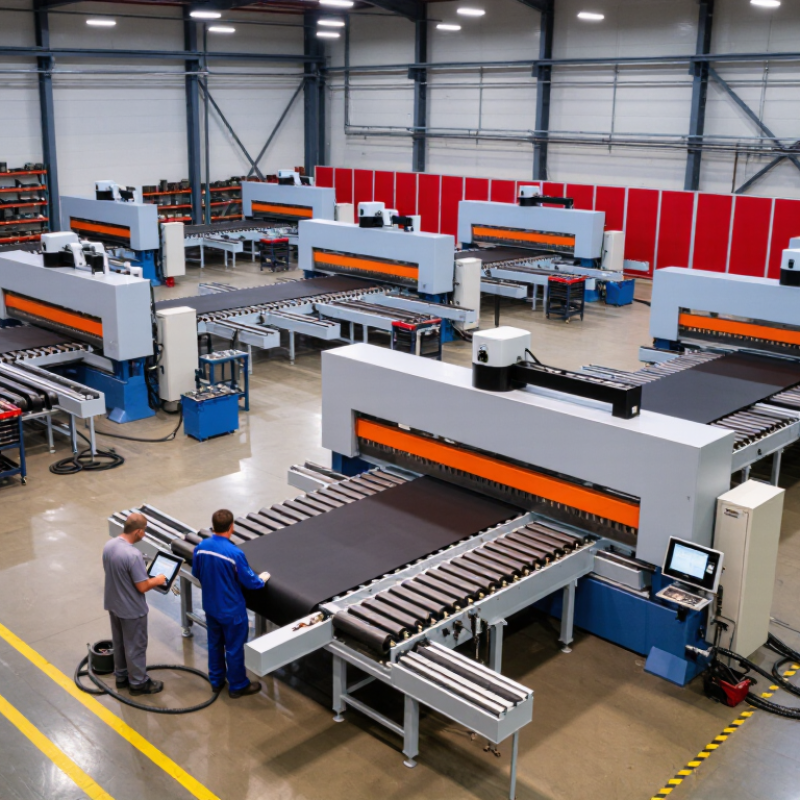
What Is a Conveyor Belt Beam Cutting Press?
A conveyor belt beam cutting press is an industrial machine that applies controlled force through a broad moving beam. It presses a shaped die into belt material, cutting parts such as strips, pads, or component blanks. The workpiece rests on a cutting surface, while the operator positions the die and selects suitable pressure and stroke settings.
These presses can handle materials such as rubber, PVC, and layered belt stock, depending on machine capacity and tooling. A larger cutting area may suit wide sheets, while a traveling beam can help cover different positions across the bed. Still, a press is not magic. Reinforcement layers, material thickness, and worn dies can affect cut quality. Uneven edges may signal a setup problem, not a need for more force.
Tips: Check the belt material and thickness before choosing a die. Make a test cut on scrap, then inspect the edge and backing surface. Keep hands clear of the cutting zone, and follow the machine’s operating instructions. Small adjustments matter.
10 Best Conveyor Belt Beam Cutting Press Factories - What Is a Conveyor Belt Beam Cutting Press?
A beam cutting press uses a press head to apply force to a cutting die, which cuts material placed on a cutting board. In conveyor-fed setups, a conveyor moves material into or out of the cutting area. There is no universal factory ranking; use the criteria below to compare manufacturers and verify each machine’s specifications for your material and production process.
| No. | Factory evaluation dimension | What to check | Useful evidence |
|---|---|---|---|
| 1 | Cutting force and material suitability | Confirm that the press’s rated force and cutting method suit the material, die, and required cut quality. | Machine specification sheet and a cutting trial using your material and die. |
| 2 | Effective cutting area | Check the usable cutting area against the dimensions and layout of the parts to be cut. | Dimensioned drawings showing the working area and cutting-head coverage. |
| 3 | Conveyor and feed arrangement | Determine whether the conveyor is integrated with the press and how material is loaded, indexed, and discharged. | Process layout, conveyor specifications, and a demonstration of the complete feed cycle. |
| 4 | Stroke and working clearance | Verify the available stroke and clearance for the material stack, cutting die, and cutting board. | Technical drawings and stated stroke and clearance measurements. |
| 5 | Cutting accuracy and consistency | Assess cut quality across the working area and repeatability over consecutive cycles. | Measured trial samples, stated tolerances, and documented acceptance criteria. |
| 6 | Controls and operating modes | Review available controls, cycle settings, operating modes, and adjustment procedures. | Control-system documentation and an operator demonstration. |
| 7 | Safety provisions | Check guarding, emergency stops, safe operating procedures, and applicable safety documentation. | Risk assessment, safety instructions, and inspection of the machine in operation. |
| 8 | Tooling and cutting-board support | Confirm compatibility with the required dies and cutting boards, including replacement and setup procedures. | Tooling requirements, setup instructions, and available replacement-part details. |
| 9 | Maintenance and serviceability | Review routine maintenance tasks, access to service points, and the recommended maintenance schedule. | Maintenance manual, parts list, and service-support terms. |
| 10 | Factory testing and after-sales support | Establish how the machine is inspected before shipment and what installation, training, and warranty support is included. | Factory acceptance-test records, commissioning plan, training scope, and written warranty terms. |
How Beam Cutting Presses Cut Conveyor Belt Materials
Beam cutting presses cut conveyor-belt stock by driving a shaped steel-rule die through rubber and textile layers. The operator places the sheet on a cutting pad, aligns the die, then lowers the press beam. Pressure shears the material along the die’s outline. This suits repeatable shapes, such as repair patches, belt components, and gasket-like parts. Small details matter. A worn die can leave fuzzy fabric edges or compressed rubber, even when the press force seems adequate.
Material construction sets the limits. Fabric-reinforced belt stock can often be cut with a correctly selected die and press capacity. Steel-cord belts need purpose-designed processing; a standard beam press is not a universal solution. Grand View Research’s 2024 Conveyor Belt Market report estimated the global market at USD 5.85 billion in 2023, reflecting broad demand for belt products, not a measure of cutting-press use. For operators, the practical checks are thickness, reinforcement, die perimeter, and cut quality across the full sheet. Test samples first. A clean edge can still hide damaged reinforcement, so inspect the cut face and confirm the belt’s intended service requirements.
Key Features of Conveyor Belt Beam Cutting Presses
These presses pair a moving conveyor bed with a descending beam and steel-rule die. This setup can reduce manual repositioning when cutting repeated shapes from rubber, foam, fabric, or gasket sheet. Look for adjustable cutting pressure and stroke depth; thick rubber needs a different setup from thin fabric. Even beam loading matters. Uneven force can leave one edge partly uncut, even when the center looks clean. Bed size, beam clearance, and die dimensions should suit the largest routine part, not just an occasional oversized job. Small mismatch, big waste.
Feed control is equally important. Variable conveyor speed, accurate indexing, and reliable material sensors help keep each blank aligned beneath the die. Operators should be able to pause the feed and access the work area without bypassing guards or interlocks. Check how the press handles scraps and belt tracking; a drifting belt can quietly shift cut positions. Useful controls show pressure, cycle count, and fault status clearly. Maintenance access matters too. Daily checks of guides, hoses, and belt tension can prevent avoidable downtime, though they cannot fix a poorly designed die. During a production trial, pay attention to vibration, noise, and variation between batches. A faster cycle is not always better.
Key Features of Conveyor Belt Beam Cutting Presses
Theoretical cutting force at selected hydraulic pressures, calculated for a 200 mm bore cylinder. Actual force may be lower due to system losses and machine design.
Calculation: force = pressure × piston area. Values are engineering calculations, not specifications for any particular factory or machine.
Criteria for Evaluating Beam Cutting Press Factories
Choosing a conveyor belt beam cutting press factory starts with the machine’s real working range. Ask what belt materials, widths, and thicknesses the press can process consistently. A capable factory should explain cutting force, beam travel, table size, and positioning accuracy in plain terms. Request a sample cut using material similar to yours. Check the edges for fraying, uneven compression, or heat marks. Small details matter.
Evaluate how the factory verifies performance, not just how it describes it. Review inspection records, component specifications, and documented acceptance tests. Ask operators to demonstrate setup, tool changes, emergency stops, and routine maintenance. Clear answers are a good sign. So are accessible service parts and practical training. Check whether guarding and interlocks suit the intended production workflow, and confirm that controls are easy to understand under shop-floor conditions. A clean showroom can impress, but it does not prove long-term reliability. Factory visits and customer references help, though neither replaces a material-specific trial. Compare delivery schedules, installation support, warranty terms, and the process for resolving faults. No evaluation removes every risk; even a detailed checklist can miss how a machine behaves during a busy shift.
Profiles of 10 Notable Conveyor Belt Beam Cutting Press Factories
Profiles of 10 notable conveyor belt beam cutting press factories reveal different strengths: heavy-frame builders prioritize rigidity, while servo-focused plants emphasize controlled stroke speed. Integrated belt converters may offer matched cutting dies and material handling. Other factories specialize in hydraulic presses, multi-station layouts, compact footprints, high-tonnage work, custom tooling, or after-sales service. These are useful comparison categories, not a universal ranking. A factory’s published speed can look impressive, but real output depends on belt thickness, die changes, and operator workflow.
The 2024 MHI Annual Industry Report found that 55% of surveyed companies were increasing investment in supply-chain technology. That trend makes automation-ready presses worth examining, especially for plants seeking repeatable feeding and inspection. Ask each factory for cycle-time tests using your material, plus sample-cut results and maintenance intervals. Check guarding, spare-part availability, and training support. Details matter.
Tips: Bring a representative belt sample and a drawing of the finished part to factory trials. Record cut quality, setup time, and scrap. A small omission in the test plan can distort the comparison; I would also verify quoted performance under realistic shift conditions.
English
Français 