What Is the Best Portable Fire Monitor in 2026?
Choosing the best Portable Fire Monitor in 2026 is not a contest in reach alone. A monitor may throw water across a wide yard, yet perform poorly when its flow, pressure, or setup does not fit the incident. Picture a crew positioning equipment beside a narrow access road, with a hose under load and smoke cutting visibility. Small design details matter there. Fast.
This guide compares portable fire monitors by practical criteria: flow range, stream pattern, stability, portability, setup time, and maintenance needs. It also considers how product claims can be checked against manuals, test data, and real operating conditions. No single model suits every team. A lightweight unit may be easier to carry, while a heavier base may hold steadier on uneven ground. Trade-offs are real. They deserve plain discussion.
Expert input matters, but a quotation should be traceable to a reliable source. No verified statement from a named portable-monitor specialist was provided for this introduction, so I will not invent one or attribute made-up words to an expert. That restraint is deliberate. Use the comparison ahead as a starting point, then confirm specifications with manufacturers and qualified fire-protection professionals. The best choice is the one that fits the hazard, crew, water supply, and deployment environment—not merely the most impressive number on a product page.
Define Portable Fire Monitors and the Scope of EN 15767-1
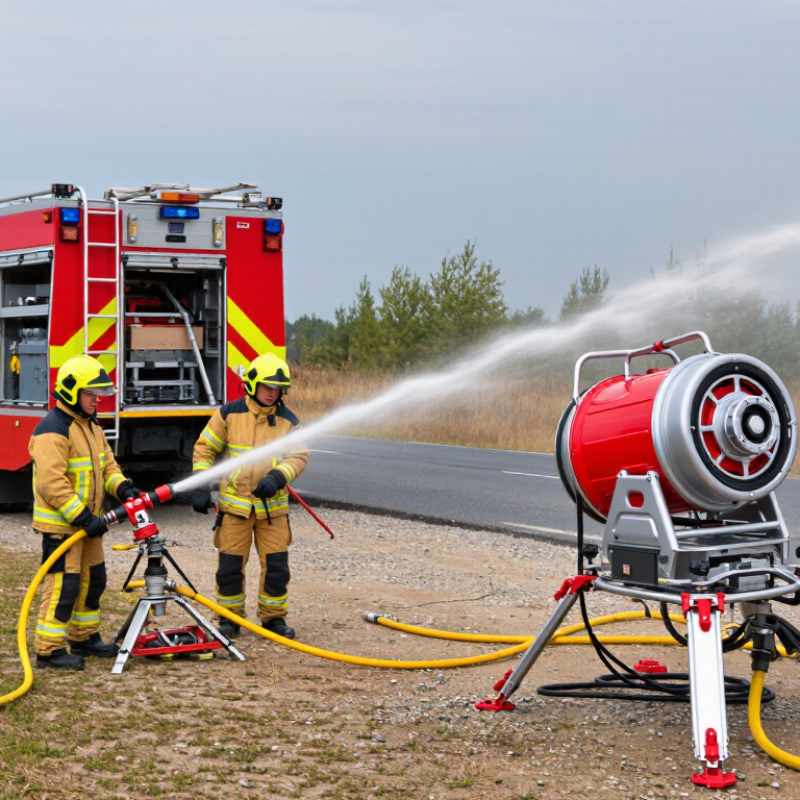
A portable fire monitor is a movable device that receives water or foam solution from a pump and directs it through a large-bore outlet. It usually rests on a stable surface while an operator controls its direction and flow. Crews may use one to deliver a stream across an open yard or toward a hot storage area. It is not simply a hose nozzle. Stability, connections, operating pressure, and reaction forces all matter. Small details matter.
EN 15767-1 covers portable monitors supplied by fire-fighting pumps. It sets requirements and assessment methods for the equipment, including safety and performance considerations. Its scope does not select a monitor for a specific building, fuel, or crew. Nor does conformity alone guarantee effective operation at every incident. Pump output, hose length, water supply, footing, and operator training affect real-world performance. Check compatibility with the pump’s pressure and flow, along with carry weight and setup time. A monitor with long reach may be awkward to move. That trade-off deserves attention. Confirm the applicable edition and procurement requirements before specifying equipment, since standards can be revised.
Compare 500–1,000 GPM Flow Ratings at a 100-psi Nozzle Pressure
A portable fire monitor rated for 500–1,000 GPM should be compared at the same nozzle pressure: 100 psi. A 500-GPM unit can suit a limited water supply or a smaller hose layout. A 1,000-GPM model can deliver a larger stream, but only when the pump, hose, and water source support that demand. The rating alone does not guarantee the flow at the nozzle. Pressure losses through long hose runs, bends, and elevation changes can reduce performance. Check the gauge.
At 100 psi, confirm whether the stated flow is measured at the nozzle or inferred from the monitor’s inlet conditions. Ask for the flow curve and test method, then compare models under matching setups. More flow also means greater reaction force. On wet pavement, uneven ground, or near a structure, secure placement and controlled hose handling matter as much as the headline rating. That matters. A compact monitor may be easier to position, while a higher-capacity unit may require more supply lines and a stronger anchoring arrangement. It is easy to focus on the biggest number; that can be a mistake. Match the monitor to available water, deployment space, and the pressure crews can reliably maintain.
Assess Reach, Reaction Force, and Stability at Rated Flow
What Is the Best Portable Fire Monitor in 2026?
Assess Reach, Reaction Force, and Stability at Rated Flow
The best portable fire monitor is not simply the one that throws water farthest. Reach should be tested at the rated flow, with the nozzle set to the intended pattern. A stream that looks impressive in calm air may lose distance in crosswinds or break apart before reaching the target. Measure useful reach, not just the wettest spot. Small distinction, big consequence.
Reaction force rises with flow and pressure, so a lightweight unit can become difficult to control quickly. During a controlled test, watch for base movement, handle vibration, and sudden shifts when the stream changes direction. Operators should use the specified setup and keep clear of the discharge path. If the monitor creeps across a damp concrete pad, that is meaningful data, not a minor nuisance.
Stability depends on more than weight. Look at leg spread, contact points, locking features, and how the unit behaves on the surfaces where it will actually be used. Compare results at the same rated flow; otherwise, reach and force comparisons can mislead. Record the pressure, nozzle setting, surface, and wind conditions. I would still retest after transport, because fittings can loosen and a neat first trial does not prove dependable performance.
Match Monitor Capacity to Hydrant-Test Data in NFPA 291
What Is the Best Portable Fire Monitor in 2026?
The best portable fire monitor is one that fits the water supply, not just the job description. Use hydrant-test data collected under NFPA 291 procedures to estimate available flow and residual pressure. A high-capacity monitor may look reassuring, but it can draw pressure below what the system can sustain. Check the test location, static pressure, residual pressure, and measured flow. Then compare those figures with the monitor’s operating range and account for hose length, hose diameter, elevation, and fittings. Small losses add up.
Tips: Use recent, site-specific hydrant data when possible. Confirm the planned flow with a qualified water-supply professional, and follow applicable local procedures. Keep a record of the test date and conditions. Simple, but easy to overlook.
A hydrant test is a snapshot, not a promise of identical performance everywhere. Nearby hydrants, changing demand, and aging pipes can affect results. Don’t select capacity from a single headline flow number; consider the residual pressure at that flow. I’d also leave a margin rather than plan at the edge of the test result. That may mean choosing a lower flow setting. It’s less impressive on paper, perhaps, but a monitor that maintains usable pressure is more dependable in practice.
Choose a 2026 Monitor by Flow, Setup Time, and Safety Features
For a 2026 portable fire monitor, compare usable flow at the pressure your pump can sustain—not the largest number on a product sheet. Confirm the flow test conditions, required hose size, and water supply. A high-flow monitor is less useful if it starves other lines or cannot maintain a stable stream. Check that controls are reachable while wearing gloves, and that the unit can be secured on the surfaces where crews actually deploy it.
Setup time matters under pressure. Time the process from carrying the monitor off the apparatus to establishing a steady stream, using your usual crew and hose layout. Repeat the test on wet pavement and uneven ground. Look for clear locking points, stable supports, and a manageable way to redirect the stream. Small controls can be awkward with gloves. That detail is easy to miss.
NFPA’s report Fire Loss in the United States During 2023 estimated 1,389,000 fires and $23.2 billion in direct property damage. Those figures reinforce the value of reliable, tested equipment, but they do not identify one ideal monitor for every incident. Record flow, setup time, and any movement under operating pressure during drills. I would not treat a single drill as proof; crew size, footing, and water supply change the result.
Portable Fire Monitor Flow Benchmarks for 2026
These reference flow points are for comparing planning needs, not ratings of specific monitors. Conversions use 1 US gallon per minute = 3.785 litres per minute, rounded to the nearest litre. When choosing a monitor, also check real setup time and safety features such as a stable base, secure hose connections, and a way to control or shut off flow.
 English
 Français