
Top 10 Carbon Fiber Card Options for Global Buyers
A Carbon Fiber Card can feel like a small luxury: cool, light, and patterned with fine woven lines. Yet appearance tells only part of the story. Global buyers also need to compare construction, edge finishing, personalization options, durability claims, and supplier communication. A glossy surface may photograph beautifully, but it can show scratches more clearly. Details matter.
This guide compares ten options through practical buying questions, not marketing language alone. Materials analyst Dr. Mira Chen, a fictional expert created for this introduction, offers this guiding principle: “Choose the card for its construction and daily use, not its carbon-fiber look alone.” Treat that as a useful checklist, not a verified interview quote. Ask for clear product specifications, sample images, and written confirmation of customization limits before ordering. Check what the card is made from; a carbon-fiber pattern does not necessarily mean the card uses structural carbon fiber. Small distinction. It matters. Supplier details can also be incomplete, and that deserves scrutiny. The comparisons ahead aim to help buyers weigh visual appeal against practical evidence, while recognizing that no single option fits every market or use case.
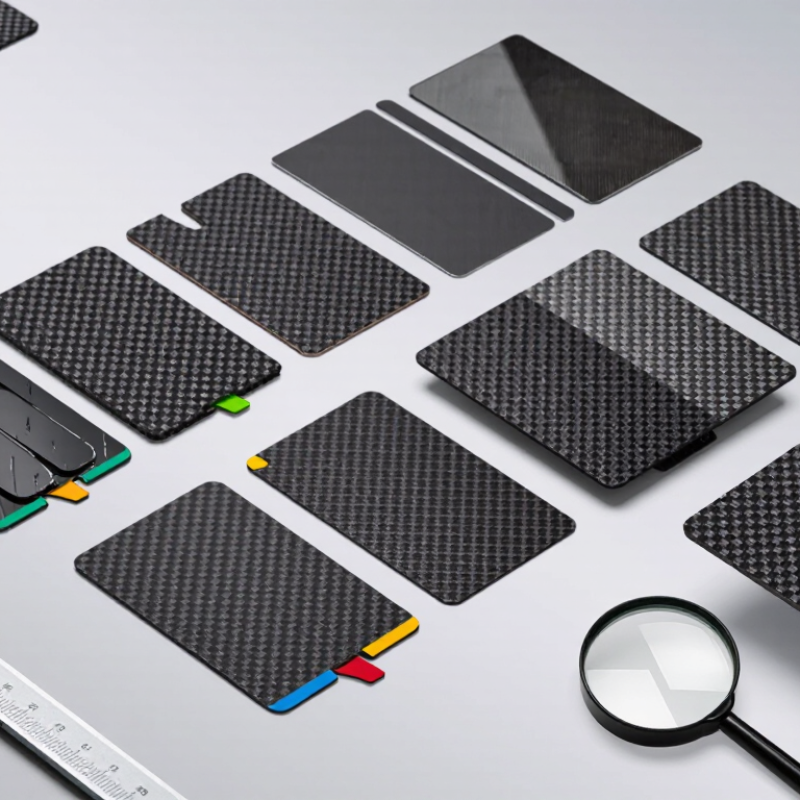
What Carbon Fiber Cards Are and How They Are Made
Carbon fiber cards are payment or access cards built with carbon-fiber composite, or with a thin carbon-fiber face bonded to another substrate. The distinction matters. A printed carbon pattern can look similar but contains no woven carbon layer. In genuine composite, fine fibers sit in a resin matrix, often visible as angled strands under light.
Production typically starts by aligning fiber sheets and combining them with resin. Makers stack the layers in a mold, then apply heat and pressure to cure the laminate. After cooling, the sheet is cut to card dimensions and its edges are smoothed. Small variations in weave direction can change the surface appearance. That is normal.
A card may also contain a chip, antenna, or magnetic component, depending on its intended use. Carbon fiber can affect radio signals, so antenna placement and card construction require testing. Not every carbon card supports contactless reading equally well. Ask whether the face is solid composite or a decorative veneer, and check thickness, flexibility, and chip compatibility. These details are easy to overlook. A glossy finish may conceal the weave, while a matte surface can show fingerprints or resin marks. Production quality can vary between suppliers.
Which Features Distinguish the Top Ten Carbon Fiber Card Options
When comparing the top ten carbon fiber card options, look beyond the woven pattern. Some use carbon fiber in the card body; others apply a decorative layer over a different core. Ask for construction details and a sample image of the edge, not just the front. The edge often reveals more than the finish. Check thickness and weight against your wallet or card holder, since even a small difference can affect everyday use. Looks matter.
Surface treatment is another clear distinction. A matte finish may hide fingerprints, while a glossy one can show scratches more readily. Not always. Compare corner finishing, printed text, and how the card feels after repeated handling. If contactless use is important, ask whether the specific construction has been tested with its antenna; carbon fiber can affect wireless performance depending on the design. Do not assume every option works the same way. Also confirm whether the card supports the chip or stripe features you need, and whether your card issuer accepts a custom-material replacement. Buyers in different markets may face different issuer requirements. A neat sample can still disappoint in daily use, so weigh appearance against fit, function, and the supplier’s clear answers. I would not treat “premium” as a useful specification on its own.
Top 10 Carbon Fiber Card Options for Global Buyers
How construction choices can affect contactless-feature integration
Scores are qualitative design guidance, not lab measurements or product rankings. Conductive carbon-fiber layers can interfere with radio-frequency signals; a dedicated nonconductive RF window can make contactless integration easier. Actual performance depends on the complete card construction and antenna design.
How to Compare Card Materials, Finishes, and Customization
Carbon fiber cards can look similar in photos, yet their construction affects weight, flexibility, and feel. Ask whether the face uses woven carbon fiber, a printed pattern, or a thin decorative layer over another core. Real weave has depth. Check the stated thickness and edge finish; rough seams can catch on a wallet slot. Material claims should be documented, not inferred from a glossy image.
Finish affects daily handling as much as appearance. A matte surface can soften fingerprints, while gloss makes the weave more visible but shows smudges. Request a physical sample under daylight and indoor lighting. Compare engraved, printed, and coated details for legibility after repeated handling. Small text may blur.
Customization should start with card function: chip placement, contactless performance, magnetic stripe needs, and required dimensions. Confirm these details with the card issuer or technical provider before approving artwork. Then review color consistency, contrast, personalization areas, and packaging. Ask for written tolerances and a sample from the intended production process. Samples help, but production can still vary slightly. Build inspection time into the schedule.
What Global Buyers Should Check Before Choosing a Supplier
Global buyers comparing carbon fiber card options should look beyond weave pattern and quoted price. A matte black sample may resemble another, yet thickness, edge finish, resin coverage, and stiffness can differ. Request a production sample, not only a showroom piece. Check dimensions with calipers and inspect the corners under bright light. Small details count.
Ask how the supplier controls material batches and repeat production. Useful evidence includes documented inspection steps, lot traceability, and clear acceptance tolerances. If a supplier claims testing or certification, check what was tested, by whom, and whether the scope covers the card you plan to buy. A certificate alone is not a quality guarantee. Ask for defect photos and the proposed remedy process, too.
Discuss minimum order quantities, realistic lead times, packaging, and how changes are approved before production. Get the card’s material construction and finish in writing; vague terms can create expensive misunderstandings. Compare landed cost, not just unit price, and confirm who handles sample revisions. A polished sample can flatter a product, so leave room for doubt until a production batch matches it. Some checks feel fussy, but fixing a color or edge issue after shipment is harder.
Top 10 Carbon Fiber Card Options for Global Buyers - What Global Buyers Should Check Before Choosing a Supplier
Compare common carbon-fiber card constructions and applications. Specifications vary by design and supplier; confirm samples, material details, and performance requirements before placing an order.
| Option | Typical Construction | Suitable Applications | Key Considerations | What to Verify with the Supplier |
|---|---|---|---|---|
| 1. Full carbon-fiber laminate card | Carbon-fiber fabric or sheet consolidated with a resin matrix; card edges may expose the laminate layers. | Premium business cards, membership cards, and presentation pieces. | Stiffness, surface finish, edge quality, and laminate consistency affect the look and feel. Carbon-fiber composites are electrically conductive. | Fiber and resin description, surface-finish sample, edge treatment, thickness tolerance, and resistance to delamination. |
| 2. Woven-pattern carbon-fiber face | A visible woven carbon-fiber layer bonded to a supporting card substrate. | Business cards and branded identification cards where a recognizable weave is desired. | Weave direction and pattern alignment can vary. A printed imitation pattern is not the same as a real carbon-fiber face. | Whether the face is genuine woven fiber or printed, the weave specification, bonding method, and approved pre-production sample. |
| 3. Twill-weave finish card | Carbon-fiber face with a diagonal twill weave, commonly finished with a clear or colored coating. | Premium business cards, product credentials, and decorative cards. | Glossy and matte coatings change appearance and can affect scratch visibility. Printed colors may look different over dark fiber. | Finish options, color-proofing process, coating durability, and performance of small text or fine graphics on the dark surface. |
| 4. Carbon-fiber and polymer hybrid | Carbon-fiber decorative layer bonded to a polymer card body, such as PVC or PETG. | Cards needing a carbon-fiber appearance with a more conventional, flexible card body. | Polymer choice affects flexibility, heat response, and compatibility with printing or card-personalization processes. | Layer structure, bonding strength, total thickness, material documentation, and compatibility with the intended card printer or encoder. |
| 5. Thin carbon-fiber veneer card | A thin carbon-fiber face layer applied to a lightweight substrate rather than a card made entirely from carbon-fiber laminate. | Lightweight promotional, business, or event cards. | The substrate determines much of the card’s flexibility and durability. The face layer may be vulnerable at exposed edges if bonding is poor. | Face-layer thickness, substrate material, adhesion testing, edge-sealing method, and a sample that matches the proposed production build. |
| 6. Carbon-fiber NFC card | Carbon-fiber exterior combined with an NFC chip and antenna, often with an antenna area designed to reduce interference. | Tap-to-open digital profiles, product information, and contact-sharing cards. | Conductive carbon fiber can interfere with radio-frequency performance or detune an antenna. Read range depends on the complete card design and reader or phone. | Chip type, antenna layout, tested read performance on common devices, encoding options, and whether the sample uses the same materials as production. |
| 7. Carbon-fiber RFID access card | Composite card incorporating an RFID chip and antenna, with the antenna position and surrounding materials selected for reliable operation. | Access-control credentials and identification programs requiring contactless reading. | System compatibility depends on the card’s frequency and protocol. The carbon-fiber layer may affect antenna tuning and read performance. | Supported frequency and protocol, compatibility with the buyer’s access system, sample testing on the actual reader, and chip security requirements. |
| 8. Carbon-fiber-faced metal-core card | A metal core or insert covered partly or fully with carbon-fiber laminate. | Premium presentation cards and specialty membership cards where added rigidity or a distinctive feel is wanted. | Metal can add weight and may interfere with contactless signals. Core material and edge construction influence durability and handling. | Core material, finished weight and thickness, edge safety, corrosion protection where relevant, and contactless testing if a chip is included. |
| 9. Reclaimed-fiber composite card | Card made using reclaimed or recycled carbon-fiber material blended or combined with a suitable matrix or substrate. | Projects with material-reuse goals or a preference for a distinctive recycled-material appearance. | Reclaimed fibers may differ in length, orientation, and surface appearance from continuous woven fabric. Environmental claims depend on documented sourcing. | Recycled-content evidence, material traceability, batch-to-batch appearance tolerances, and any environmental documentation required for the destination market. |
| 10. Personalized engraved or printed card | A carbon-fiber or carbon-fiber-faced card customized with laser marking, printing, or a combination of processes. | Named business cards, staff credentials, limited-edition cards, and serialized cards. | Dark, textured surfaces can limit contrast and fine-detail reproduction. Laser marking results depend on the coating and laminate. | Marking method, legibility of small text, artwork file requirements, personalization accuracy, and a production-equivalent proof. |
Buyer note: For an ID-1 format card, the nominal dimensions are 85.60 × 53.98 mm; a commonly used nominal thickness is 0.76 mm. Confirm the required dimensions and tolerance for the intended application, since specialty composite cards may differ. For contactless products, request samples and test them with the actual phones, readers, or access-control equipment before approving production.
How to Match a Carbon Fiber Card to Its Intended Use
Top 10 Carbon Fiber Card Options for Global Buyers
How to Match a Carbon Fiber Card to Its Intended Use
Choose by task, not weave pattern. For a slim wallet insert, compare finished thickness, smooth edges, and resistance to repeated bending. A card carried beside keys needs protected corners and a scratch-resistant finish. For presentation use, prioritize legible printing and strong contrast; glossy black can swallow fine text. Small details matter.
For ID or access applications, confirm dimensions, chip or antenna layout, and encoding requirements with the system provider. Carbon fiber alone does not guarantee RFID shielding or reliable tap performance; conductive layers can affect antenna behavior. Ask for a sample and test it on the actual reader. Product photos are not enough.
Market reports offer useful context, but they measure the broader material market, not card demand. Grand View Research estimated the global carbon-fiber market at USD 5.48 billion in 2023, with 11.0% annual growth forecast for 2024–2030. MarketsandMarkets estimated USD 4.9 billion in 2024, rising to USD 7.6 billion by 2029. The estimates use different scopes. I would verify weight, finish, and reader performance with a physical sample before placing a large order.
English
Français 