China Top 10 SMT Reflow Oven Manufacturers in 2026?

    China’s electronics manufacturing base continues to expand, creating strong demand for reliable Smt Reflow Oven systems. These machines control soldering quality, thermal stability, production speed, and energy use across modern PCB assembly lines.

    Industry evidence supports this market direction. The IPC Global Sentiment of the Electronics Industry reports continuing investment in automation, capacity, and manufacturing efficiency. SEMI’s World Fab Forecast also records sustained global investment in semiconductor production, which indirectly strengthens demand for advanced assembly equipment. Market research from Grand View Research and MarketsandMarkets similarly identifies automation, miniaturized components, and higher throughput as major equipment trends.

    However, purchasing decisions require more than market growth figures. A reflow oven must maintain stable temperature zones, accurate conveyor movement, nitrogen control, and repeatable thermal profiles. For example, a 12-zone system may look impressive, yet poor airflow can still create uneven solder joints on dense boards. That detail matters.

    This guide reviews China’s top 10 Smt Reflow Oven manufacturers for 2026. It considers engineering capability, process support, production scale, export experience, certifications, and customer feedback. References to IPC J-STD-001 and IPC-A-610 provide useful quality benchmarks for soldering and finished assemblies.

    No ranking is perfect. Supplier websites may emphasize specifications, while users often value service response more. Some published performance claims also need independent verification. Buyers should request sample boards, thermal-profile records, factory audits, and lifecycle support details before choosing a supplier. The strongest manufacturers are not always the largest. Reliability is proven on the production floor.
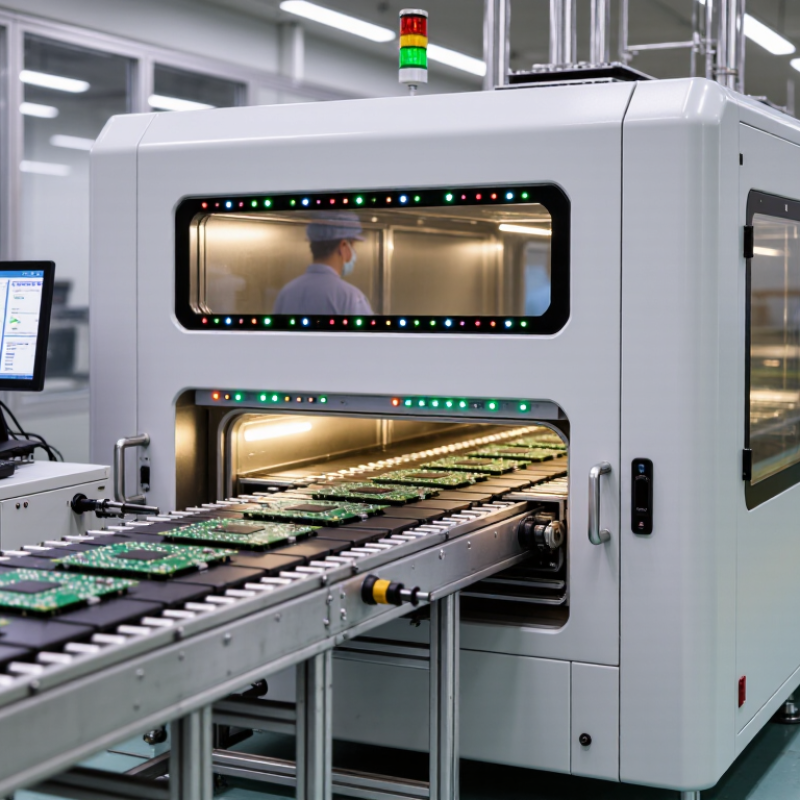
    China Top 10 SMT Reflow Oven Manufacturers in 2026?

    What Defines a Leading SMT Reflow Oven Manufacturer in China

    A leading SMT reflow oven manufacturer in China is defined by process control, not catalog size. Research and Markets’ 2024 outlook places reflow oven demand on a mid-single-digit annual growth path through the decade. That growth increases pressure on suppliers to prove stability. A serious manufacturer should show thermal-profile records, calibration routines, and repeatability data. Ask for results across lead-free alloys, fine-pitch components, and heavy copper boards. One impressive demo is not enough.

    IPC’s 2024 electronics industry survey found that roughly six in ten respondents expected higher sales over the following six months. More production requires dependable equipment and responsive technical support. A leading supplier should provide zone-by-zone temperature control, nitrogen management, conveyor accuracy, and traceable maintenance. Operators also need practical training, not only manuals translated into English. Visit an operating line if possible. Watch how quickly engineers diagnose an offset profile or unstable cooling zone. Small delays become expensive.

    Energy use deserves closer attention. Some market assessments estimate that thermal processing can represent a meaningful share of SMT line electricity consumption, especially during continuous operation. Manufacturers should disclose heating efficiency, standby consumption, and recovery time. Data can be incomplete. That matters. Buyers should question vague claims and request independent measurements. The best evaluation may include a difficult board, repeated runs, and an uncomfortable discussion about failure limits.

    China’s SMT Reflow Oven Market and Manufacturing Landscape in 2026

    China’s SMT reflow oven market is becoming more technical in 2026. Demand comes from electric vehicles, communication equipment, industrial controls, and compact consumer electronics. Local manufacturers now focus on stable heat zones, accurate conveyor control, nitrogen efficiency, and production data tracking. The details matter. A few degrees of temperature drift can change solder quality across a full panel.

    The manufacturing landscape is also more specialized. Production clusters combine sheet-metal processing, heating components, control systems, and automation suppliers. This structure supports shorter delivery times and practical customization. Buyers often request different chamber lengths, conveyor widths, cooling sections, or software interfaces.

    Experienced manufacturers usually test temperature uniformity with thermal profiling before shipment. They should also provide maintenance guidance, spare-part access, and clear electrical documentation.

    A reliable top-ten evaluation should examine more than factory size or export volume. Product consistency, engineering response, safety design, energy use, and after-sales support deserve equal attention. Site audits can reveal useful details, such as wiring quality, calibration records, and operator training. One weakness remains: public market data is not always complete or comparable. Therefore, rankings may reflect available evidence rather than absolute performance. I would review sample boards, profile reports, warranty terms, and operating costs before making a purchasing decision. Performance on paper is not enough.

    Profiles of the Top 10 SMT Reflow Oven Manufacturers in China

    Profiles of the Top 10 SMT Reflow Oven Manufacturers in China

    This 2026 profile examines ten leading Chinese SMT reflow oven manufacturers through practical purchasing criteria. The selection considers engineering depth, production capacity, export experience, service coverage, and documented thermal performance. It does not rely only on factory size or online visibility.

    Several profiled manufacturers focus on compact ovens for laboratories and small-batch assembly. Others build wide conveyor systems for automotive, lighting, and communication electronics. Their equipment commonly includes multiple heating zones, closed-loop temperature control, nitrogen options, automatic width adjustment, and real-time thermal profiling. Stronger suppliers explain zone balance clearly and provide test data before shipment. That matters on the factory floor.

    Service quality differs. Some companies offer remote diagnostics, spare-part planning, and installation guidance in several languages. Others provide capable machines but limited technical documentation. This weakness deserves attention. A low purchase price may become expensive when operators cannot correct uneven solder joints quickly. Buyers should inspect sample boards, measure temperature uniformity, and verify energy consumption under actual loading.

    The ten profiles also reveal differences in customization. Some manufacturers adapt conveyor height, cooling modules, software access, or production length. Others prefer standardized platforms, which can reduce delivery risk. Published specifications are useful, but they are not always perfectly comparable. Factory visits, reference checks, and independent thermal tests remain valuable before contract approval. Reflow performance is measurable. Claims should be tested.

    Comparison of Technologies, Capacities, Prices, and Service Support

    China Top 10 SMT Reflow Oven Manufacturers in 2026

    China’s leading SMT reflow oven manufacturers compete through thermal accuracy, production capacity, pricing, and service support. Current models commonly offer eight to twelve heating zones, nitrogen capability, and closed-loop temperature control. These features help maintain stable solder profiles for dense, heat-sensitive circuit boards. Ask for measured profiling data, not attractive brochures. Small details matter.

    Capacity changes the buying decision. Compact ovens may process 300 to 600 millimeter boards per minute, while larger systems support wider conveyors and continuous factory lines. Entry-level equipment often costs about 20,000 to 45,000 US dollars. Mid-range machines may reach 50,000 to 120,000 dollars, depending on zones, cooling, nitrogen, and automation. High-capacity configurations can exceed 150,000 dollars. Published prices are rarely complete.

    Service support deserves equal attention. A dependable supplier should provide installation, operator training, recipe setup, calibration records, and accessible spare parts. Remote diagnostics can reduce downtime, but response times vary between suppliers. Request a written warranty, recommended maintenance schedule, and local support contacts. Test a real production board when possible. That reveals conveyor vibration, temperature deviation, and cooling performance. I would not rely on one factory trial alone. Some comparisons remain imperfect because energy use and long-term maintenance costs are difficult to verify before purchase.

    China Top 10 SMT Reflow Oven Manufacturers in 2026? - Comparison of Technologies, Capacities, Prices, and Service Support
    Comparative table of ten anonymized Chinese SMT reflow-oven supplier profiles. The figures represent typical published configuration ranges and prevailing 2026 ex-works market levels for comparable equipment, rather than a brand-specific quotation.
    Rank Anonymized Supplier Profile Primary Technology Heating Zones Cooling Zones Maximum PCB Width Temperature Uniformity Typical Throughput Nitrogen Capability Conveyor System Typical Price Range
    (USD, Ex-Works)
    Warranty Service Support
    1 Supplier Profile A Forced-convection hot-air reflow with closed-loop PID control 10–12 2–3 400 mm ±1.0°C to ±1.5°C 600–900 mm/min Optional / low-oxygen package Stainless-steel mesh with edge support 18,000–32,000 12 months Remote commissioning, spare-parts supply, application support, and regional service partners
    2 Supplier Profile B High-efficiency forced convection with independent zone control 12–14 3–4 450 mm ±0.8°C to ±1.2°C 700–1,000 mm/min Available; oxygen levels typically below 1,000 ppm Dual-rail or mesh conveyor 26,000–45,000 12 months Installation guidance, online diagnostics, process profiling, and consumable recommendations
    3 Supplier Profile C Convection reflow with modular heating and automatic recipe management 8–10 2 350 mm ±1.5°C to ±2.0°C 400–700 mm/min Optional Mesh conveyor with adjustable rail width 15,000–25,000 12 months Standard remote support, operator training, and one-year technical consultation
    4 Supplier Profile D Long-profile convection oven for lead-free and high-mass assemblies 14–16 3–5 500 mm ±0.8°C to ±1.2°C 800–1,200 mm/min Integrated nitrogen-ready design Heavy-duty chain or mesh conveyor 38,000–65,000 12–18 months Factory acceptance testing, installation support, recipe development, and preventive-maintenance guidance
    5 Supplier Profile E Compact convection system for low-to-medium volume production 6–8 1–2 300 mm ±1.5°C to ±2.5°C 250–500 mm/min Optional, mainly for selected processes Mesh conveyor 9,000–17,000 12 months Video-based setup, remote troubleshooting, spare-parts packages, and basic operator training
    6 Supplier Profile F High-volume convection reflow with optimized airflow and heat recovery 12–16 3–4 450 mm ±0.8°C to ±1.0°C 800–1,300 mm/min Integrated nitrogen control available Precision chain conveyor with center support 42,000–72,000 12 months On-site commissioning options, process optimization, remote monitoring, and structured spare-parts support
    7 Supplier Profile G Convection and vapor-phase-compatible production platform 10–12 2–3 400 mm ±1.0°C to ±1.5°C 500–900 mm/min Optional Mesh or pinless chain conveyor 24,000–40,000 12 months Application engineering, profile verification, remote service, and replacement-heater availability
    8 Supplier Profile H Energy-saving convection oven with variable-speed exhaust management 10–14 2–4 450 mm ±1.0°C to ±1.5°C 600–1,000 mm/min Optional low-oxygen configuration Stainless-steel mesh or chain conveyor 22,000–39,000 12 months Remote support, energy-use consultation, maintenance schedules, and multilingual documentation
    9 Supplier Profile I Wide-board convection reflow for LED, power electronics, and large PCB assemblies 14–18 3–5 600 mm ±1.0°C to ±1.5°C 600–1,100 mm/min Available for lead-free production Heavy-load chain conveyor with adjustable rail 45,000–85,000 12–18 months Layout planning, installation assistance, thermal profiling, and optional local technician support
    10 Supplier Profile J Entry-level lead-free convection reflow with touchscreen control 7–9 1–2 350 mm ±1.5°C to ±2.0°C 300–600 mm/min Optional Mesh conveyor with manual width adjustment 12,000–21,000 12 months Online installation guidance, basic profile setup, standard spare-parts support, and operator manuals
    Notes: Price ranges exclude freight, import duties, taxes, installation travel, nitrogen-generation equipment, and customized options. Throughput depends on board size, component density, solder-paste profile, conveyor speed, and loading method. Temperature-uniformity figures should be confirmed through a factory acceptance test using the buyer’s actual PCB or a representative thermal-load board. Warranty and service terms vary by contract, destination, and configuration.

    How to Select the Right Chinese SMT Reflow Oven Manufacturer

    How to Select the Right Chinese SMT Reflow Oven Manufacturer

    China’s SMT reflow oven market offers many choices, but specifications alone can mislead. A 2024 MarketsandMarkets report valued the global SMT equipment market at approximately US$5.1 billion. It also forecasts continued growth through 2029, driven by automotive, telecommunications, and consumer electronics production.

    Check thermal performance before discussing price. Ask for zone temperature uniformity, conveyor stability, nitrogen control, and verified profiling results. A practical test should use your actual PCB, solder paste, and component mix. Request data from several production runs, not one successful demonstration.

    IPC J-STD-001 provides useful soldering requirements for evaluating process control and operator training. ISO 9001 certification can support reliability, but it does not prove reflow quality.

    Inspect the factory remotely or in person. Review calibration records, spare-parts availability, service response times, and software update procedures. Ask whether engineers can diagnose uneven heating from exported profile data.

    Small details matter. A weak exhaust seal may increase operating costs. Poor conveyor design can also damage delicate boards. I would not accept impressive brochures without traceable test evidence. Even experienced buyers sometimes overvalue the lowest quotation. That mistake can create hidden downtime, inconsistent solder joints, and expensive production delays.