 English
 Français

How to Choose a Lithium Battery for Golf Cart?
Choosing a Lithium Battery For Golf Cart is not just a matter of picking the largest capacity or the lowest price. The battery must match your cart’s voltage, available space, expected range, and daily workload. A two-seat cart on flat paths has different needs from a loaded cart climbing steep hills. Check the manufacturer’s specifications before comparing models. Small details matter.
Battery researcher Dr. Jeff Dahn is a recognized authority on battery performance. A relevant takeaway from his research, paraphrased rather than presented as a direct quotation, is: “Battery life depends on how cells are used and charged.” Apply that principle by checking the battery management system, charger compatibility, continuous and peak current ratings, and the seller’s warranty. Ask how the battery performs during repeated acceleration, not only under ideal test conditions. Also confirm that its dimensions and terminals fit your cart without improvised changes. One point deserves a second look: advertised range can vary with hills, passenger weight, temperature, and driving habits. The label alone cannot promise your route. In this guide, we’ll look at the practical checks that help you choose confidently—and the compromises worth questioning before you buy.
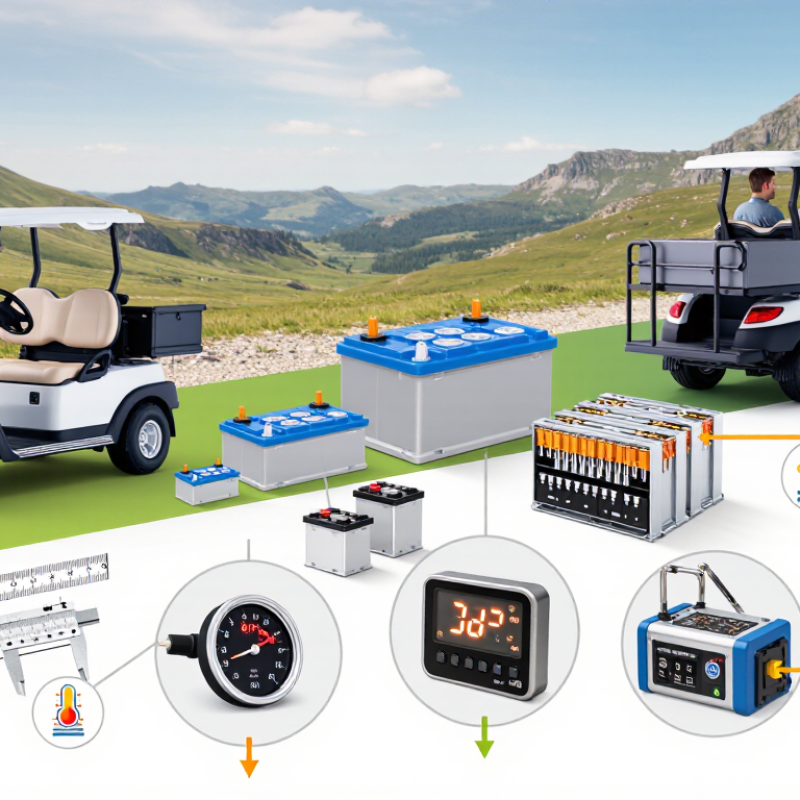
Assess Your Golf Cart’s Voltage and Battery Requirements
Before choosing a lithium battery, confirm your golf cart’s required system voltage. Check the owner’s manual or the label on the existing battery pack. Common systems use 36, 48, or 72 volts, but the correct value depends on the cart. Count the batteries and note how they are connected; a series connection adds their voltages. Do not rely on appearance alone. A quick label check can prevent an expensive mismatch.
Voltage is only part of the fit. Check the motor controller’s current demands and the battery’s continuous and peak output ratings. Consider how you use the cart: steep paths and heavy loads can require more power than short, flat trips. Measure the battery compartment, then compare its length, width, height, and terminal positions with the replacement pack. Small details matter. Confirm that the charger is compatible with the battery’s chemistry and charging profile, too. This step is easy to overlook, and it deserves a second check. If specifications are unclear, ask a qualified cart technician to verify them before installation. A battery can fit the space and still be the wrong electrical match.
| What to Check | Common Golf Cart Setup | Lithium Battery Consideration | How to Verify |
|---|---|---|---|
| Cart system voltage | Many carts use a 36 V or 48 V battery system. | Choose a lithium battery pack designed for the cart’s system voltage. LiFePO₄ packs commonly use 12 cells in series for 38.4 V nominal, or 16 cells in series for 51.2 V nominal. | Check the cart manual, controller label, or existing battery-pack wiring. Do not select a pack based only on a single battery’s voltage. |
| Existing battery configuration | A 36 V lead-acid pack may use six 6 V batteries. A 48 V pack may use six 8 V batteries or four 12 V batteries. | The replacement lithium pack usually replaces the complete series-connected bank; it is not generally a one-for-one replacement for each individual lead-acid battery. | Count the batteries and confirm how they are connected. Verify the total pack voltage before ordering. |
| Nominal and full-charge voltage | “36 V” and “48 V” are system classes; actual battery voltage changes with charge level. | A 12-cell LiFePO₄ pack is about 38.4 V nominal and 43.8 V at 3.65 V per cell. A 16-cell pack is about 51.2 V nominal and 58.4 V at 3.65 V per cell. | Confirm that the battery’s charge voltage is within the controller and cart electrical system’s allowed range. |
| Capacity (amp-hours) | Required capacity depends on route length, passenger and cargo weight, terrain, speed, and accessory use. | Compare usable energy and expected operating time, not just the amp-hour number. Lithium batteries typically provide a higher usable share of rated capacity than lead-acid batteries, but actual performance varies by model and conditions. | Use the cart’s typical daily distance and the battery’s rated watt-hours (nominal volts × amp-hours) to compare options. Allow extra capacity for hills, heavy loads, and cold conditions. |
| Controller current demand | The motor controller draws high current during acceleration and hill climbing; demand varies by cart. | The battery’s battery-management system (BMS) must support the cart’s continuous and peak current requirements. Insufficient current capability can cause power limits or shutdowns. | Check the controller’s current rating and compare it with the battery’s BMS continuous and peak discharge ratings. |
| Charger compatibility | Lead-acid chargers may use charging stages or voltage settings unsuitable for lithium batteries. | Use a charger approved for the battery chemistry and its required pack voltage and charging profile. Do not assume the original charger is compatible. | Check the battery and charger specifications, including output voltage, charging current, and any required temperature protections. |
| Physical fit and connections | Battery trays, hold-downs, cables, and terminals differ between carts. | A lithium pack may be smaller or lighter than the original bank, but it still needs secure mounting, suitable cable size, and correctly rated connections. | Measure the battery compartment and confirm terminal orientation, cable reach, mounting method, and any required adapters. |
| Cart-specific electronics | Some carts have voltage-sensitive displays, solenoids, converters, or other accessories. | Check that the lithium pack’s voltage range and any required communication or low-voltage signals work with the cart’s components. | Review the cart service documentation and battery specifications; consult a qualified technician if compatibility is unclear. |
Note: Battery specifications and cart requirements vary. Confirm voltage, current limits, charger compatibility, and physical fit with the cart and battery documentation before installation.