How to Choose Rebar Wire Rod for Global Projects?
Choosing Rebar Wire Rod for global construction projects requires more than comparing price per tonne. The right selection begins with project conditions, applicable standards, and the final reinforcement process. Diameter consistency matters when wire drawing or cold forming follows delivery. Chemical composition matters even more. Carbon, manganese, sulfur, and phosphorus levels influence strength, ductility, weldability, and fatigue performance. Small variations can create serious production problems.
Edwin Basson, Director General of worldsteel, has said, “Steel is essential to modern society.” That principle is practical here. Rebar Wire Rod supports bridges, towers, tunnels, ports, and industrial foundations. Buyers should request mill certificates, heat numbers, mechanical test results, and independent inspection records. Traceability must continue from furnace to coil and from shipment to fabrication. A reliable supplier should explain production tolerances clearly. Avoid vague promises.
The project location also changes the decision. Humid coastal air may require stronger corrosion controls. Remote sites may need heavier coils, stronger packaging, or different delivery schedules. Check container limits, port handling, storage conditions, and customs documentation before placing an order. A technically suitable rod can still fail commercially if it arrives damaged or late.
Real experience teaches caution. A specification can appear complete yet miss the buyer’s actual forming conditions. That weakness deserves honest review. Ask whether the selected Rebar Wire Rod performs consistently on the customer’s machines, not only in laboratory reports. Compare samples, verify supplier history, and test a trial batch before full production. Quality is measurable. Reliability is earned over repeated deliveries.
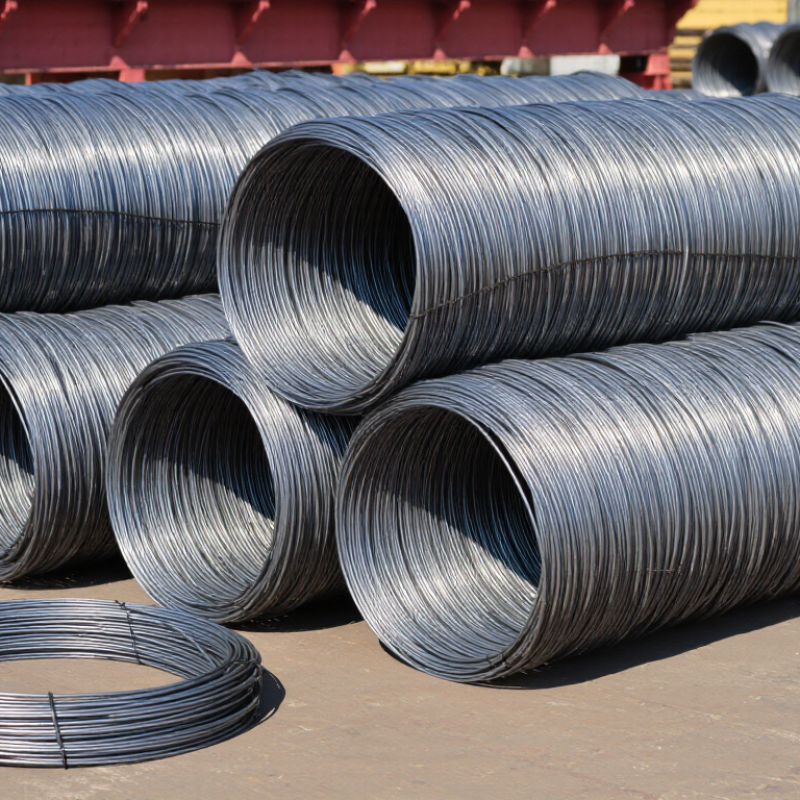
Define Rebar Wire Rod and Its Role in Global Construction
Rebar wire rod is a hot-rolled steel product supplied in coils, not finished reinforcement bars. Fabricators draw, straighten, cut, or weld it into reinforcing wire, mesh, ties, and small structural components. Its role is practical: it converts mill-produced steel into reinforcement that controls cracking and carries tension inside concrete. The final performance depends on more than nominal diameter.
For a global project, buyers should review grade, carbon equivalent, tensile strength, yield behavior, ductility, and weldability. Diameter tolerance matters when automated machines feed thousands of meters of rod. Coil weight affects crane handling, container loading, and storage safety. A dusty yard, coastal air, or long sea voyage can damage poorly protected material. Request a traceable heat number, test certificate, dimensional report, and inspection plan before shipment. Do not rely on appearance alone.
Experienced procurement teams compare the rod with the concrete design, fabrication equipment, and regional standards. A product that performs well in one market may need different documentation or ductility limits elsewhere. Clear records help engineers verify chemistry and strength without guessing. Small details matter. Yet paperwork is not perfection. Sampling errors, inconsistent coils, or unclear translations can still create costly rework. Independent inspection and a trial fabrication run often reveal problems earlier than a warehouse check.
Identify Project Standards, Grades, Sizes, and Performance Requirements
How to Choose Rebar Wire Rod for Global Projects?
Choosing rebar wire rod starts with the project’s governing standard. Confirm whether the design follows ASTM, EN, JIS, or another national code. Do not assume one grade transfers directly between systems. Grade names may look similar, but yield strength, tensile strength, elongation, and test methods can differ. In project reviews, I check the specification, approved drawings, and local authority requirements together. This prevents a costly mismatch between purchased wire rod and finished reinforcement.
Size selection needs equal attention. Verify nominal diameter, dimensional tolerance, coil weight, and available decoiling equipment. A small tolerance issue can affect bending accuracy and bar geometry. Review chemical limits, carbon equivalent, weldability, and surface condition before ordering. For seismic or fatigue-sensitive structures, request suitable ductility and cyclic-performance data. Mill certificates should match the heat number, test results, and inspection plan. Laboratory verification is still wise.
Tips: Build a comparison sheet for standards, grades, sizes, and performance criteria. Ask the supplier to confirm every deviation in writing. Check delivery coils physically when possible. Labels can be correct, yet handling damage may remain unnoticed. I have seen teams focus on tensile strength and overlook elongation or welding behavior. That was an expensive lesson. Also, environmental exposure may require additional corrosion protection, but the correct solution depends on design life and regional conditions. Safety margins should be reviewed, not guessed.
How to Choose Rebar Wire Rod for Global Projects?
Identify project standards, grades, sizes, and performance requirements before approving a wire rod or reinforcing-steel supply.
Compare Suppliers, Material Quality, Certifications, and Production Capacity
Choosing rebar wire rod for global projects requires more than comparing price per tonne. A supplier’s annual output can look impressive, yet capacity may disappear during peak construction periods. The World Steel Association reported global crude steel production of about 1.89 billion tonnes in 2023. That scale shows market strength, but it does not prove reliable delivery. Request monthly production figures, available rolling lines, billet sources, export records, and realistic lead times.
Material quality must match the project specification, such as ASTM, EN, or JIS requirements. Check carbon content, tensile strength, elongation, surface condition, and dimensional tolerance. Each coil should carry a heat number linked to a mill test certificate. Independent inspection can verify sampling and loading procedures. Certifications such as ISO 9001 support process control, while ISO 14001 may clarify environmental management. Still, certificates can become outdated. Verify their scope and validity directly with the issuing body.
Tips: Compare three suppliers using one technical checklist. Ask for recent test results, not selected samples. Confirm whether capacity is reserved in writing. The OECD steel market reports repeatedly highlight demand volatility and trade-related supply risks, so contingency planning matters. A cheaper offer may fail after port delays, quality claims, or replacement production. My own view is imperfect: certification reduces uncertainty, but it never replaces physical inspection and careful contract terms.
| Evaluation Dimension | Benchmark / Requirement | Supplier Profile A | Supplier Profile B | Supplier Profile C | Verification Documents or Tests | Procurement Assessment |
|---|---|---|---|---|---|---|
| Product form | Hot-rolled, continuously cast steel wire rod supplied in coils and suitable for downstream rebar, mesh, or cold-forming applications. | Hot-rolled wire rod; coil supply available | Hot-rolled wire rod; coil supply available | Hot-rolled wire rod; coil supply available | Mill product description, coil tag, heat number, packing list | Essential match |
| Typical wire-rod diameter range | Common commercial range: approximately 5.5–16 mm, subject to mill capability and final rebar process requirements. | 5.5–13 mm | 5.5–16 mm | 6–12 mm | Technical data sheet, dimensional inspection report, calibrated micrometer records | Profile B offers the widest stated range |
| Applicable product standards | Standards must match the destination market and the final product. Relevant references may include EN 10016, ISO 16120, ASTM A510/A510M, or an approved project specification. | EN 10016 / ISO 16120 available | EN 10016 / ISO 16120 / ASTM A510/A510M available | ASTM A510/A510M available | Signed compliance statement, standard edition, purchase specification | Profile B has broader stated coverage |
| Steel grade control | Grade, chemical composition, mechanical properties, and intended end use must be stated on the purchase order and mill certificate. | Grade-specific production | Grade-specific production with heat-level traceability | Grade-specific production | Heat analysis, product analysis where required, mill test certificate | Heat-level traceability preferred |
| Chemical composition | Carbon, manganese, silicon, sulfur, phosphorus, and any alloying elements must comply with the selected standard; limits vary by grade and market. | Heat chemistry reported | Heat chemistry and product chemistry available on request | Heat chemistry reported | EN 10204 3.1 certificate, laboratory test report, spectrometer records | Do not accept generic chemistry ranges |
| Mechanical properties | Tensile strength, yield or proof strength where applicable, elongation, and bending or ductility requirements must follow the selected standard or project specification. | Tensile and elongation reported | Tensile, elongation, and ductility data reported by heat | Tensile and elongation reported | Accredited tensile-test report, sampling plan, test method reference | Profile B provides stronger traceability |
| Dimensional tolerance | Diameter, ovality, coil weight, and surface condition must comply with the agreed product standard and project tolerance. | Standard dimensional inspection | Dimensional inspection by coil and heat | Standard dimensional inspection | Inspection and Test Plan, dimensional report, calibration certificates | Define tolerances before order confirmation |
| Surface condition | Surface should be free from harmful cracks, seams, laps, excessive scale, oil contamination, and corrosion that could affect downstream processing. | Visual inspection and descaling control | Visual inspection with documented nonconformance procedure | Visual inspection | Visual inspection report, defect classification, photographs where needed | Required for reliable drawing or rolling |
| Quality management certification | ISO 9001 certification is a strong baseline for a global industrial supply chain; certificate scope must cover steel production or relevant manufacturing activities. | ISO 9001 certificate available | ISO 9001 certificate with manufacturing scope | ISO 9001 certificate available | Valid certificate, accreditation body, scope, expiry date, surveillance status | Verify certificate validity independently |
| Environmental and occupational systems | ISO 14001 and ISO 45001 can support environmental and worker-safety requirements in international projects, although they are not substitutes for product certification. | ISO 14001 available; ISO 45001 project-dependent | ISO 14001 and ISO 45001 available | ISO 14001 project-dependent | Current certificates, audit scope, environmental declarations where required | Important for ESG-controlled projects |
| Material certification | EN 10204 Type 3.1 is commonly requested for independently traceable material certification; project contracts may require additional inspection or Type 3.2 certification. | EN 10204 3.1 available | EN 10204 3.1 standard; 3.2 subject to third-party inspection | EN 10204 3.1 available | Certificate linked to heat number, coil number, grade, and test results | Profile B is suitable for stricter inspection plans |
| Production capacity category | Capacity should be evaluated by confirmed annual wire-rod output, rolling-line availability, and capacity reserved for the project—not by total group steel capacity. | Medium: approximately 0.3–0.8 million tonnes/year of wire rod | Large: approximately 0.8–1.5 million tonnes/year of wire rod | Small to medium: approximately 0.15–0.5 million tonnes/year of wire rod | Audited capacity statement, rolling-line list, production records, utilization data | Confirm project allocation in writing |
| Monthly shipment capability | Shipment plan should cover the project schedule, port cut-off dates, vessel availability, and required safety stock. | Approximately 25,000–65,000 tonnes/month | Approximately 65,000–125,000 tonnes/month | Approximately 12,000–40,000 tonnes/month | Rolling production schedule, order backlog, logistics plan, export history | Capacity must be checked against peak demand |
| Heat and coil traceability | Each coil should remain traceable to the heat, grade, size, production date, test results, and shipping documents. | Heat number and coil tag traceability | Heat, coil, test, and shipping-document linkage | Heat number and coil tag traceability | Traceability exercise using a randomly selected coil number | Mandatory for dispute prevention |
| Independent inspection | For high-value or high-risk projects, pre-shipment inspection by an agreed independent inspection body should be included in the quality plan. | Available at buyer's cost | Available under agreed Inspection and Test Plan | Available at buyer's cost | Approved inspector, inspection release note, sampling and retest procedure | Recommended for first orders |
| Packaging and corrosion protection | Coils should be securely compacted, tagged, protected against handling damage, and prepared for the expected sea or inland transport conditions. | Standard export coil packing | Export packing with project-specific marking available | Standard export coil packing | Packing specification, photographs, marking layout, loading supervision report | Specify packaging before production |
| Recommended supplier-selection position | Selection should balance compliance, traceability, confirmed capacity, logistics reliability, and total delivered cost rather than unit price alone. | Suitable for medium-volume projects with standard certification needs | Suitable for large, multi-country, or tightly scheduled projects | Suitable for smaller or phased projects after capacity confirmation | Technical bid evaluation, factory audit, reference checks, trial order | Use a weighted technical-commercial score |
Evaluate Logistics, Packaging, Customs, and Delivery Risks
How to Choose Rebar Wire Rod for Global Projects?
Rebar wire rod selection involves more than diameter, tensile strength, and chemical composition. Logistics can change the real project cost. Confirm the coil weight before booking transport. A 2.2-ton coil may require different lifting equipment than a 1.5-ton coil. Check port handling limits, inland road restrictions, and seasonal congestion. A delivery buffer of seven to fourteen days is often practical, though every route behaves differently.
Packaging deserves close inspection. Use strong steel straps, edge protection, waterproof paper, and raised supports where moisture exposure is likely. Ask for clear coil tags showing heat number, size, weight, and destination. Photograph the loaded cargo before departure. This small record can support claims if coils arrive with rust, broken straps, or distorted shapes. I once underestimated humidity during a sea voyage. The packaging looked adequate, but condensation still marked several coils. That mistake was preventable.
Tips: Compare container, breakbulk, and truck options using total landed cost. Include port storage, demurrage, insurance, and repacking charges. Prepare the commercial invoice, packing list, certificate of origin, mill test certificate, and correct customs classification early. Confirm import requirements with a qualified customs broker. Delivery terms must define responsibility for damage, inspection, unloading, and delays. Never rely only on the supplier’s estimated arrival date. Track vessel schedules and keep a backup delivery window. Small omissions create expensive delays.
Select the Best Rebar Wire Rod Through a Total-Cost Assessment
How to Choose Rebar Wire Rod for Global Projects?
Select the Best Rebar Wire Rod Through a Total-Cost Assessment
A low unit price does not always produce the lowest project cost. Assess the full landed cost before approving a supplier. Include material price, inland transport, ocean freight, insurance, duties, port handling, and local delivery. Add inspection and testing expenses. These details can change the decision quickly.
Confirm the required diameter, grade, tensile strength, elongation, and chemical limits. Different markets may follow different technical standards. Request mill test certificates, heat numbers, dimensional records, and third-party inspection options. Traceability matters when thousands of coils enter a large construction site. Check coil weight, packing quality, and moisture protection. Poor packaging can create rust, handling delays, and avoidable rejection.
Lead time also has a price. A delayed shipment may stop fabrication teams, crane schedules, or concrete work. Compare production capacity, shipping routes, customs experience, and replacement procedures. A spreadsheet can still mislead. Exchange rates, port congestion, and steel-price changes are difficult to predict. Use realistic risk allowances, not optimistic assumptions. I have seen buyers focus on a small discount and overlook expensive rework.
Tips: Compare at least three delivered-cost scenarios. Ask for a clear validity period. Verify documents before payment. Calculate cost per usable tonne, not quoted tonne. Keep a contingency for delays.
English
Français