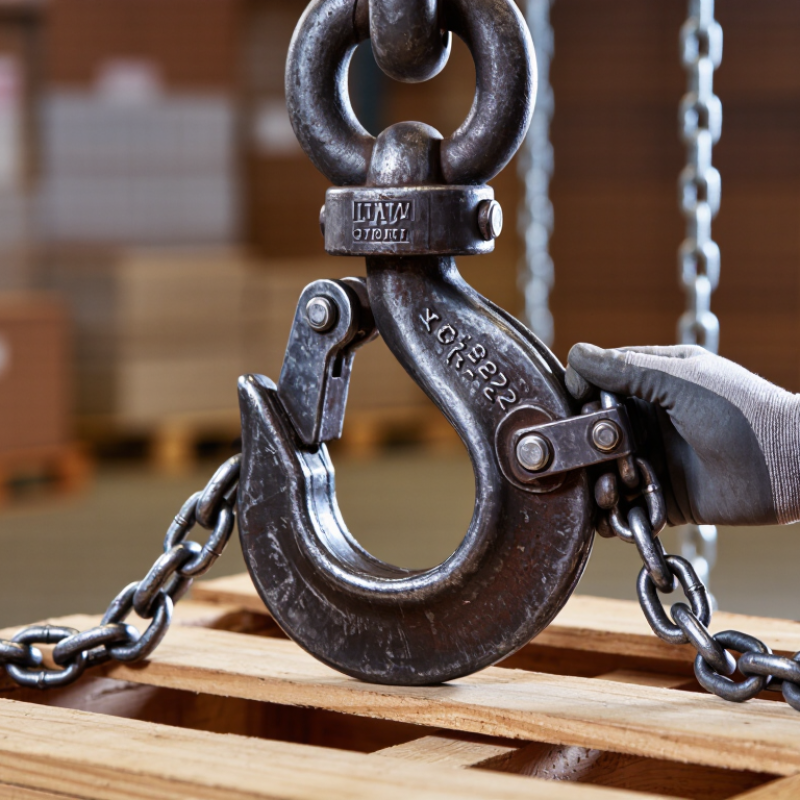
| Intended Application | Confirm whether the hook is for shortening a chain sling, connecting components, or another lifting configuration. Check chain size, grade, working angle, and environmental conditions. | Application must match the hook manufacturer’s rated use and the applicable lifting-accessory requirements. | Written application data is completed before quotation: chain diameter, chain grade, working load limit, temperature, corrosion exposure, and connection arrangement. | Technical datasheet, dimensional drawing, application instructions, and compatibility statement. | High |
| Working Load Limit | Check the marked WLL for the exact hook size and configuration. Do not substitute breaking load for WLL. | WLL should be established using a documented design and proof-test basis. For chain sling components, the complete assembly must be rated by its weakest component. | Permanent WLL marking is legible and matches the catalogue, drawing, test report, and purchase specification. | Product label or marking photograph, rated-load table, design calculation summary, and lot-specific test documentation. | High |
| Design and Manufacturing Standard | Identify the standard used for hook design, manufacture, inspection, and marking; verify that the standard fits the destination market and application. | ASME B30.10 addresses hooks used with lifting equipment. EN 1677-1 covers components for slings and includes general manufacturing and safety provisions. EN 818 series covers short-link lifting chains and related requirements. | The supplier names the exact edition and scope of the standard instead of using a generic “international standard” statement. | Standards compliance matrix, controlled drawings, manufacturing specification, and third-party or internal conformity report. | High |
| Material and Heat Treatment | Verify steel grade, forging or casting route, heat-treatment condition, and mechanical-property requirements. | Material selection must be suitable for the design load, impact requirements, wear, and operating temperature. The applicable product standard controls the required properties. | Material grade and heat-treatment condition are specified on the purchase order and traceable to each production lot. | Material test certificate, heat-treatment record, chemical composition, tensile results, impact results where required, and hardness record. | High |
| Proof Testing | Confirm that finished hooks or representative production lots are proof tested at the required load without permanent deformation or unacceptable damage. | Proof-test requirements depend on the applicable product standard and design. Proof load is not the same as WLL or ultimate breaking load. | Test load, method, acceptance criteria, equipment calibration, operator, date, and lot identification are recorded and reproducible. | Lot-specific proof-test certificate, test procedure, calibrated-machine certificate, and nonconformance disposition records. | High |
| Breaking or Destructive Testing | Determine whether qualification or periodic destructive testing is required for the design and material. | Destructive-test frequency and acceptance criteria should follow the declared standard, engineering specification, or customer qualification plan. | Qualification testing is completed for a new design, material change, or major process change; results are linked to the design revision. | Destructive-test report, specimen identification, load-versus-displacement data where available, and engineering approval. | Medium |
| Marking and Traceability | Check permanent identification of WLL, size or chain diameter, grade where applicable, manufacturer or batch identification, and inspection status. | Marking must remain legible during the intended service life and must comply with the applicable standard and destination-market rules. | Every hook can be traced from physical marking to production lot, material certificate, heat treatment, inspection, and test records. | Marking specification, traceability procedure, sample photos, batch register, and certificate-to-product cross-reference. | High |
| Safety Latch and Retention | For hooks supplied with latches, inspect latch fit, spring function, retention, deformation resistance, and compatibility with the hook throat. | A latch helps retain an unloaded connection but does not replace correct loading, proper seating, or a rated self-locking design. | Latch operates freely, closes fully, is not load-bearing unless specifically designed for that purpose, and has replacement parts available where applicable. | Latch drawing, functional inspection record, assembly instructions, and replacement-part specification. | High |
| Dimensional and Visual Inspection | Inspect throat opening, body section, pin or bowl geometry, surface condition, cracks, laps, sharp edges, and deformation. | Dimensions and defect limits should follow the approved drawing and applicable lifting-component standard. | 100% visual inspection is completed; critical dimensions are checked at a defined frequency using calibrated gauges. | Inspection plan, measurement records, gauge-calibration certificates, surface-inspection method, and defect photographs. | High |
| Non-Destructive Examination | Assess whether magnetic-particle or other suitable examination is needed for forged, heat-treated, or highly loaded areas. | NDT method and sampling rate should be defined by the product standard, design risk, material, and customer specification. | Critical load-bearing areas receive documented NDT at the specified frequency, with qualified personnel and controlled acceptance criteria. | NDT procedure, personnel qualification records, inspection reports, equipment verification, and rejected-part records. | High |
| Certification and Market Access | Distinguish between a product conformity document, a test certificate, a quality-management certificate, and a voluntary certification mark. | ISO 9001 certifies a quality-management system, not the lifting capacity of a particular hook. For the European market, determine whether the product is a lifting accessory subject to applicable CE and technical-file obligations. | Supplier identifies the legal manufacturer, applicable legislation, conformity route, language requirements, and responsible-person documentation for the destination market. | Declaration of conformity where legally applicable, technical file index, ISO 9001 certificate scope, product certificates, and user instructions. | High |
| Supplier Quality System | Evaluate control of design changes, purchasing, incoming materials, production, inspection, calibration, nonconforming product, and corrective action. | ISO 9001 is a useful management-system reference, but certification must be valid, in scope, and issued by a properly accredited certification body. | Certificate scope includes the relevant manufacturing activity; audit findings and corrective actions are available for review under confidentiality controls. | Valid certificate, scope statement, process flow, inspection plan, calibration list, internal-audit summary, and corrective-action examples. | Medium |
| Production Capacity and Process Control | Confirm forging, heat treatment, machining, coating, testing, and final inspection capacity for the required volume. | Critical processes should be controlled in-house or through approved, audited subcontractors with full traceability. | Capacity plan supports forecast demand without bypassing proof testing, inspection, or traceability controls. | Process-flow chart, equipment list, monthly capacity plan, subcontractor register, and maintenance records. | Medium |
| Change Notification | Check how the supplier controls changes to material, tooling, heat treatment, dimensions, subcontractors, coating, or manufacturing location. | Safety-critical changes require documented technical review and customer notification before shipment. | No material or process change is implemented without revision control, risk review, validation testing where required, and written approval. | Change-control procedure, revision history, engineering-change form, and customer-notification template. | High |
| Corrosion Protection | Match the finish to storage, transport, humidity, salt exposure, chemicals, and temperature. Verify that coating does not hide cracks or damage. | Coating is a corrosion-control measure and does not increase WLL unless specifically included in the design qualification. | Finish, thickness or treatment, packaging, shelf-life expectations, and inspection method are specified for the destination environment. | Finish specification, coating or treatment record, salt-spray data where relevant, packaging specification, and visual-inspection report. | Medium |
| Documentation Package | Confirm that documents are complete, consistent, legible, and available in the required language before shipment. | Documents should support safe use, inspection, maintenance, traceability, and regulatory obligations in the destination market. | Purchase order, drawing, certificates, instructions, packing list, and product markings contain consistent model, size, batch, and WLL information. | Document index, certificate pack, user manual, inspection checklist, spare-part list, and retention-period statement. | High |
| Pre-Shipment Inspection | Use a risk-based inspection covering quantity, dimensions, markings, surface condition, latch operation, packaging, and documents. | Inspection scope should be agreed in the purchase contract and should not replace the supplier’s own required inspections. | Critical characteristics are checked before release; sampling levels and acceptance criteria are documented and agreed in advance. | Inspection and test plan, pre-shipment report, photographs, sampling record, and release authorization. | Medium |
| Supplier Reliability | Review on-time delivery, defect rate, response time, corrective-action effectiveness, warranty history, and document accuracy. | Supplier performance should be measured with objective records rather than references or marketing claims alone. | Use a documented scorecard with defined targets, for example: on-time delivery, lot acceptance, response time, and repeat nonconformance rate. | 12-month performance data, customer-reference process, corrective-action log, business-continuity plan, and escalation contacts. | Medium |
| Commercial and Contract Controls | Define technical specifications, approved deviations, inspection rights, document deadlines, warranty, recall support, and liability responsibilities. | Safety-critical specifications should be part of the purchase contract, not only an informal quotation attachment. | No substitution of material, design, process, or factory is permitted without written approval and updated documentation. | Signed technical agreement, approved drawing, inspection clause, warranty terms, deviation form, and complaint-escalation procedure. | High |
| Final Sourcing Decision | Combine technical compliance, evidence quality, supplier capability, landed cost, lead time, and total risk. | A lower purchase price is not an acceptable reason to waive load testing, traceability, marking, or applicable legal requirements. | Approve only suppliers that pass all critical safety gates and achieve the agreed minimum score for quality, documentation, delivery, and risk control. | Completed supplier audit, weighted evaluation sheet, approved-supplier record, risk register, and corrective-action plan for open issues. | High |
 English
  Français