Top 10 Marble Cutting Disc Types for Global Buyers
Choosing the right Marble Cutting Disc can decide whether a slab leaves a clean edge or a costly chip.
Global buyers often compare diamond concentration, segment design, bond hardness, diameter, arbor size, and cooling requirements. These details matter because marble varies in density, thickness, finish, and cutting environment. A disc used on a soft white marble may behave differently on dense black marble with mineral inclusions. Small differences can become visible around sink openings, stair edges, and polished countertops.
This guide reviews the top 10 Marble Cutting Disc types for professional workshops, fabricators, contractors, and serious distributors. It considers continuous-rim, turbo, segmented, electroplated, vacuum-brazed, and specialized profile-cutting designs. Each type has practical strengths, limitations, and suitable applications. Wet cutting may reduce dust and heat, while dry cutting can improve mobility on smaller jobs. Neither option is universally better.
That point deserves attention.
Selection should also include cutting speed, kerf width, machine power, operator control, and expected service life. Product specifications should be checked against verified test data, manufacturer guidance, and local workplace requirements. In my experience, buyers sometimes focus only on initial price. That can be a mistake. A low-cost disc may produce slower cuts, rougher edges, or more frequent replacements.
No disc fits every project. The best decision balances material behavior, production volume, finish expectations, and total operating cost. Some recommendations may require testing, because real stone can be unpredictable. The following comparison offers a practical starting point for more confident purchasing decisions.
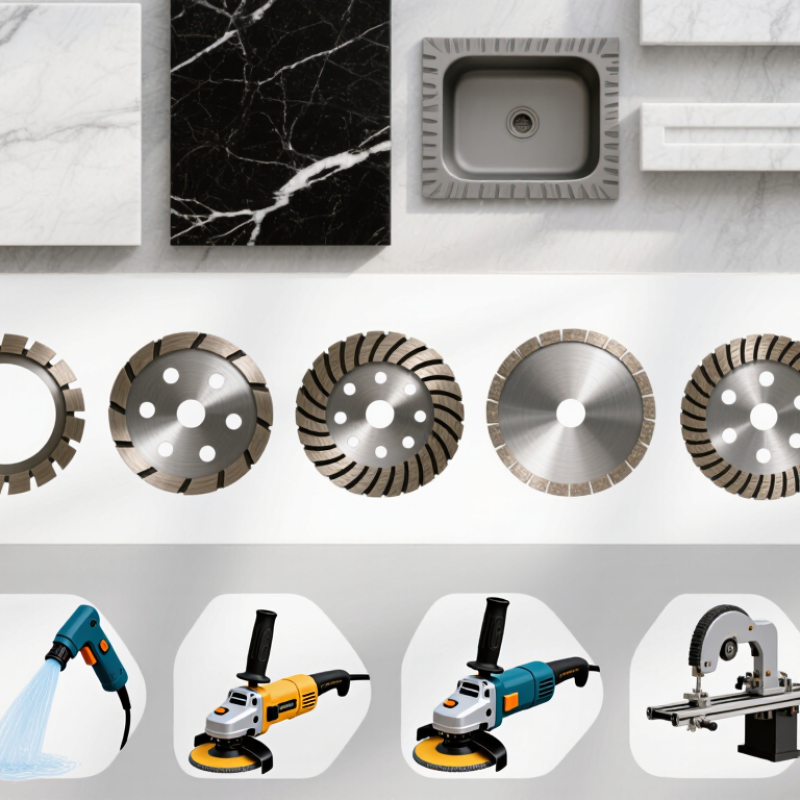
Marble Cutting Disc Taxonomy: 10 Types by Bond, Edge, and Grit
Top 10 Marble Cutting Disc Types for Global Buyers
Marble Cutting Disc Taxonomy: 10 Types by Bond, Edge, and Grit
Choosing a marble cutting disc starts with its bond. Resin-bond discs include continuous-rim, turbo-rim, and segmented designs. Continuous rims produce clean edges on polished slabs. Turbo rims remove material faster, but may leave light marks. Segmented resin discs cut aggressively and suit thicker marble, although chipping needs close control. Metal-bond discs offer longer wear. Their continuous and turbo edges work well on repeated production cuts. Electroplated discs expose diamond particles sharply, making them useful for precise trimming. Brazed segmented discs cut quickly, but they can feel harsh on delicate stone.
Edge shape is only half the decision. Grit changes the surface and cutting speed. Fine-grit continuous discs support smooth finishing on pale marble. Medium-grit turbo discs balance speed and edge quality. Coarse-grit segmented discs handle fast stock removal, especially on thick pieces. That makes ten practical types: three resin-bond designs, two metal-bond designs, one electroplated design, one brazed design, and three grit-focused edge combinations.
In workshop use, water cooling usually reduces dust and thermal stress. Still, excessive water can hide early chipping. Check the disc diameter, arbor size, and rated RPM before fitting it. A test cut on scrap marble reveals more than a catalog chart. I have seen fine grit cut beautifully, then load with soft stone. The “best” disc is not universal. It depends on thickness, finish expectations, machine stability, and operator pressure. Even experienced buyers sometimes choose speed over edge quality. That mistake becomes expensive near a visible corner.
Diamond Performance Metrics: 20–35% Concentration and Cutting Speed
For global buyers comparing marble cutting disc types, diamond concentration deserves careful attention. A 20–35% concentration often provides a practical balance between cutting speed, edge control, and operating cost. Lower concentration can expose fresh diamond particles quickly. This may help when cutting softer marble or producing frequent cuts. Higher concentration can improve segment durability, especially on harder stone. However, it may also increase friction and reduce cutting efficiency if the bond is too hard.
Cutting speed depends on more than diamond concentration. Rim design, diamond grit size, bond hardness, machine power, feed pressure, and water flow all affect performance. In controlled workshop tests, a disc within this concentration range can cut smoothly at a steady feed rate. Excessive pressure creates heat, discoloration, and small edge chips. Speed is not everything. Measure the kerf.
A practical test uses the same marble slab, spindle speed, and cooling volume. Record seconds per cut, edge quality, and visible diamond wear. For example, a 30% concentration disc may outperform a 20% disc on dense marble, but not on softer material. The result can change with slab thickness and operator technique. I have seen buyers select a higher concentration expecting longer life, then lose productivity through slower cutting. That assumption needs review. Specifications should be verified through sample cutting, not accepted as guaranteed results. A reliable supplier should provide concentration data, recommended parameters, and realistic tolerance ranges.
Top 10 Marble Cutting Disc Types for Global Buyers
Diamond performance benchmark: concentration and cutting speed for 20 mm marble slabs.
Continuous-rim and turbo discs generally deliver smoother marble edges, while segmented and vacuum-brazed designs prioritize higher cutting speed. Values are indicative industry benchmark ranges under comparable wet-cutting conditions; actual performance varies by marble hardness, blade diameter, machine power, feed rate, and cooling.
The Top 10 Disc Designs: Continuous, Turbo, Segmented, and Electroplated
Choosing among the top 10 marble cutting disc types starts with four core designs: continuous, turbo, segmented, and electroplated. Each pattern affects cutting speed, edge quality, cooling, and service life.
A continuous rim usually delivers the cleanest edge on polished marble, especially with steady water flow. However, it may feel slow on thick slabs. Turbo rims add narrow slots that improve debris removal and cutting speed. They suit installers handling varied marble thicknesses on busy sites.
Segmented discs use separated cutting blocks and wider gullets. This design often manages heat better during deep cuts, but it can leave a rougher edge. Careful final polishing remains necessary. Electroplated discs hold exposed diamond particles on a metal surface. They cut intricate profiles, small openings, and delicate decorative pieces effectively. Their cutting action feels sharp, though the abrasive layer may wear faster on abrasive stone or under excessive pressure.
From field use, stable machine alignment matters as much as disc design. A slight wobble can create chips near a sink cutout. I once blamed the disc for a poor edge, then found uneven clamping caused the vibration. That mistake still influences my checks. Buyers should compare diameter, arbor size, wet or dry compatibility, marble hardness, and expected cutting depth. Local water quality and dust-control rules also affect practical performance. No disc is perfect. Cost per finished meter often matters more than the purchase price.
Global Compatibility: 115–400 mm Diameters, Arbor Sizes, and RPM Ratings
Top 10 Marble Cutting Disc Types for Global Buyers
Global buyers should compare more than blade appearance. Common options include continuous-rim, turbo-rim, segmented, electroplated, vacuum-brazed, thin-rim, hybrid, silent-core, wet-cutting, and dry-cutting discs. Continuous rims usually leave cleaner edges on marble, while turbo rims remove dust and heat faster. Segmented designs cut aggressively, but they may chip polished surfaces.
Diameter affects cutting depth, machine fit, and operating speed. Popular sizes range from 115 and 125 mm for handheld tools to 180, 230, 300, 350, and 400 mm for larger saws. Arbor sizes are not globally universal. Common measurements include 22.23, 25.4, 30, and 32 mm. Always measure the spindle, flange, and mounting hole before ordering. A small mismatch can cause vibration, uneven wear, or unsafe movement. RPM ratings must match the disc diameter and machine. Never exceed the printed maximum speed.
Tips: Confirm wet or dry use, marble hardness, and edge-finish needs with the supplier. Ask for test-cut data, not only catalog claims. Inspect the disc after several cuts. I have seen buyers choose a larger diameter for depth, then discover their saw lacks sufficient power. Bigger is not always better. Also, local socket standards and machine designs can affect practical compatibility, even when the arbor appears correct.
Safety and Selection Standards: Wet/Dry Cutting and EN 13236 Requirements
Top 10 Marble Cutting Disc Types for Global Buyers
Safety and Selection Standards: Wet/Dry Cutting and EN 13236 Requirements
Marble cutting demands more than a sharp diamond edge. Continuous-rim discs usually produce cleaner cuts on polished slabs, while turbo rims remove material faster. Segmented designs may work for rough shaping, but they can leave more chips. Choose the disc according to marble hardness, thickness, machine speed, and required edge quality. A workshop test on a spare corner is safer than trusting a catalogue image.
Wet cutting helps control heat and airborne dust. Keep water flow steady across the cutting area, not only at the disc entrance. Inspect electrical connections before use, because water and damaged cables create serious hazards. Dry cutting needs effective dust extraction, short cutting passes, and cooling pauses. Never force the disc through a tight curve. It may bind, overheat, or fracture.
For international purchasing, check EN 13236 requirements for superabrasive products and review the supplier’s technical documentation. Confirm the disc diameter, bore size, maximum operating speed, intended cutting direction, and safety markings. The disc’s rated speed must exceed the machine’s working speed. Do not remove guards or bypass protective equipment. In practice, selection is rarely perfect; one disc may cut quickly but chip the edge. Record cutting results, dust levels, and wear after each trial. That simple record often exposes assumptions that looked reasonable at the beginning.
| No. | Marble Cutting Disc Type | Construction and Cutting Edge | Wet/Dry Use | Recommended Marble Applications | Typical Diameter Range | Cutting Characteristics | Key Selection and Safety Points |
|---|---|---|---|---|---|---|---|
| 1 | Continuous-Rim Sintered Diamond Disc | Fully continuous diamond rim with sintered segments bonded to the steel core. | Wet preferredDry only when permitted | Clean, chip-controlled cuts in marble slabs, tiles, vanity tops and architectural panels. | 105–400 mm for portable tools and small masonry machines; larger sizes are available for stationary saws. | Usually the smoothest cut and best edge finish. Cutting speed is moderate compared with segmented designs. | Use a rigid, correctly guarded machine. Water reduces heat and dust. Confirm that the disc is rated for marble and that the maximum operating speed is at least the machine spindle speed. |
| 2 | Turbo-Rim Diamond Disc | Continuous rim with a serrated or wave-shaped cutting edge that improves debris removal. | Wet or dry, as specified | General-purpose cutting of marble tiles, trim pieces, countertops and thin stone sections. | 105–350 mm | Faster than a plain continuous rim while generally retaining good edge quality. | Dry cutting requires effective dust extraction and respiratory protection. Avoid excessive lateral pressure, twisting and overheating, especially on thin polished marble. |
| 3 | Segmented Sintered Diamond Disc | Separate diamond segments with gullets between them for cooling and debris clearance. | Wet preferredDry versions available | Fast rough cuts, thick marble blocks, masonry saw work and applications where edge finish is less critical. | 115–500 mm for portable and site saws; larger diameters suit stationary equipment. | High material-removal rate and good cooling through the gullets, but it can produce more edge chipping than a continuous rim. | Check segment integrity before use. Do not use a disc with missing, cracked or loose segments. Wet operation is preferable for long cuts and reduced airborne dust. |
| 4 | Electroplated Diamond Disc | One or more layers of diamond particles are electrically fixed to the rim or cutting surface. | Wet or dry, as specified | Detailed shaping, small-diameter cutting, narrow kerfs, profile work and occasional marble repair work. | 50–230 mm | Very sharp initial cutting action and a thin kerf; exposed diamond gives good access to intricate areas. | Diamond exposure decreases as the plated layer wears. Do not dress, hammer or side-load the rim. Select a disc with a suitable arbor and speed rating for the tool. |
| 5 | Vacuum-Brazed Diamond Disc | Diamond particles are metallurgically brazed to the steel rim, normally in a continuous or segmented pattern. | Dry commonly usedWet if permitted | Portable dry cutting, repair work, irregular site conditions and occasional shaping of marble. | 100–230 mm | High diamond exposure and aggressive cutting with a relatively thin kerf; service life depends strongly on pressure, heat and material abrasiveness. | Use short passes and allow cooling when dry cutting. Follow the disc maker’s wet/dry instructions; water must not be used with a tool or disc combination that is not designed for it. |
| 6 | Thin-Kerf Marble Tile Disc | Ultra-thin continuous or fine turbo rim designed to minimize material loss. | Wet preferredDry options available | Thin marble tiles, mosaics, backsplashes and precision trim cuts. | 105–180 mm | Low material waste and precise cuts; more sensitive to bending, vibration and side loading than thicker discs. | Use a stable guide or tile saw, maintain a straight feed and never force the disc through the material. Verify the minimum material thickness and maximum speed markings. |
| 7 | Continuous-Rim Precision Disc for Polished Marble | Fine diamond concentration and a reinforced continuous rim optimized for surface-finish control. | Wet recommended | High-visibility edges, polished slabs, premium interior surfaces and low-chip cutting. | 200–450 mm | Excellent edge quality when used on a rigid machine with controlled feed; typically slower than coarse turbo or segmented discs. | Use abundant, clean cooling water and a properly aligned machine. Excessive feed pressure, worn bearings or poor flanges can cause vibration and edge damage. |
| 8 | Silent-Core Diamond Disc | Diamond rim mounted on a tensioned or laminated steel core designed to reduce vibration and noise. | Wet preferredDry only if marked | Large-format slab cutting, workshops, interior fabrication and noise-sensitive production areas. | 250–600 mm and larger for stationary saws | Lower operating noise and improved cut stability, with consistent performance on long straight cuts. | Do not bend, weld, modify or repair the core. Inspect for warping and tension damage. Use the correct flange diameter and spindle speed for the saw. |
| 9 | Multi-Rim or Double-Rim Diamond Disc | Two closely spaced diamond cutting rims or a reinforced rim configuration for improved stability. | Wet recommended | Thicker marble, reinforced panels and applications requiring a more stable kerf than a thin single rim. | 180–400 mm | Good rigidity and controlled cutting in deeper sections; kerf width and power demand are greater than those of thin-kerf discs. | Confirm the available machine power and cutting depth. Keep the disc perpendicular to the workpiece and never use the side faces for grinding unless specifically designed for that purpose. |
| 10 | Diamond Rim Dressing or Reconditioning Disc | Specialized diamond construction intended to restore cutting exposure or remove glazing from compatible cutting tools. | Wet commonly used | Workshop maintenance of compatible diamond tools; not a general-purpose replacement for a marble cutting disc. | 100–300 mm, depending on the machine and dressing method | Can improve cutting action on a glazed tool when the procedure is approved; incorrect use may permanently damage the disc. | Use only with an approved dressing procedure and compatible equipment. It must not be treated as a normal marble-cutting wheel. Follow all product-specific instructions and guarding requirements. |
EN 13236 selection and safety reminder: EN 13236 covers safety requirements for superabrasives, including diamond and cubic boron nitride products. Buyers should verify the applicable conformity documentation, product marking, maximum operating speed, dimensions, arbor compatibility, intended material, wet/dry limitation and machine-guard requirements. Always wear eye and hearing protection, suitable respiratory protection for dry cutting, protective footwear and task-appropriate gloves; use water suppression or dust extraction where applicable. The operating instructions for the specific disc and machine take precedence.
English
Français